Guardian blog on the various actions around the country: http://www.guardian.co.uk/books/libraries
Nicky Wire on the importance of libraries:
http://www.guardian.co.uk/books/2011/feb/07/nicky-wires-library-closures-manics
Plus a reminder about the grim future for the British Library: www.bl.uk/aboutus/governance/dcms/lbrindleyletter_nov2010.pdf
Wednesday, 9 February 2011

Celebrating Henry Watson
A special exhibition marking the centenary of Henry Watson’s death will run from Monday, 10 January until 21 February.
Dr. Henry Watson, a renowned composer and teacher was born in Accrington in 1846. In 1902 he donated the contents of his private library to the care of Manchester City Council.
Manchester Libraries and the Royal Northern College of Music are marking the centenary with a joint exhibition displaying original documents such as letters and photographs from the extensive Henry Watson archive.
http://www.manchester.gov.uk/news/article/5840/manchester_libraries_join_with_rncm_to_celebrate_the_life_of_henry_watson
Thursday, 3 February 2011
Richard III and Comedy of Errors at the Lowry
Productions of both plays by Propeller Theatre Company 9-12 March: http://www.thelowry.com/event/richard-iii
Go to Lectures!
Every Thursday from February, Islington Mill will be hosting a series of talks, performance lectures, exhibition openings and events by a range of local, national and international artists:
http://saysomethingseries.tumblr.com/
http://saysomethingseries.tumblr.com/
Visiting Professor in History - events and lectures
Prof. Andreas Fahrmeir
Johann Wolfgang Goethe-Universität, Frankfurt-am-Main
Hallsworth Visiting Professor
Programme of events
Still embarrassed by the nineteenth century? The marginalisation of nineteenth-century European History
Friday, 11 February Samuel Alexander Building, A.116 16.00 CultMEP roundtable
Conceptions of Citizenship from 1789 to the present
Thursday, 17 February, Ellen Wilkinson Building, A.2.7, 16.00 for 16.10 History Research Seminar
Economics as the driving force of political change
Monday 21 February Samuel Alexander Building, A 201, 17.00
For further information contact David Laven (david.laven@manchester.ac.uk)
Save a Library, or just love it...
Protests against Library closure around the country:
http://www.guardian.co.uk/books/interactive/2011/feb/01/library-protests-map
'Love Your Library' month in February:
http://www.manchesterjournal.com/community/ci_17271567
Also - do a course on hacking, crowd-sourcing, blogging or publishing at MadLab: http://madlab.org.uk/
http://www.guardian.co.uk/books/interactive/2011/feb/01/library-protests-map
'Love Your Library' month in February:
http://www.manchesterjournal.com/community/ci_17271567
Also - do a course on hacking, crowd-sourcing, blogging or publishing at MadLab: http://madlab.org.uk/
Wednesday, 2 February 2011
All change
There are several administrative changes in the department this semester:
Undergraduate
Dr Alan Rawes is now EAS Undergraduate Progamme Director, replacing Dr Jerome de Groot (Alan.rawes@Manchester.ac.uk)
Dr Monica Pearl is now EAS Assessment Officer,replacing Dr Kaye Mitchell (Monica.pearl@Manchester.ac.uk)
Dr Eithne Quinn is now In charge of AS Undergraduate matters (Eithne.Quinn@Manchester.ac.uk)
Postgraduate
Dr Robert Spencer is now in charge of PG Taught issues (Robert.spencer@Manchester.ac.uk)
Tuesday, 1 February 2011
Samuel Beckett Auditions
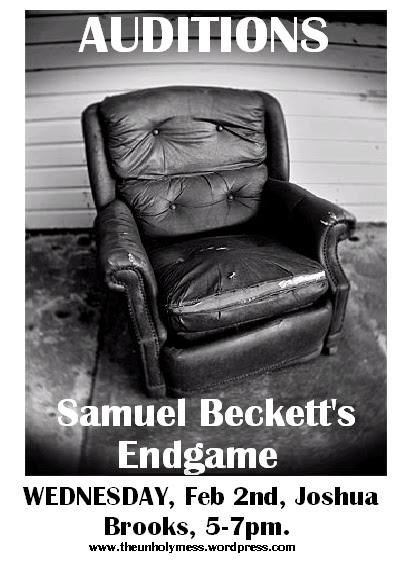
Come along and audition to be in this exciting independent production. No previous experience necessary, we are looking for enthusiastic, creative people with ideas to bring to the roles. We want to emphasise the play as a comedy, so actors should aim to draw out the pitch-black comedy in their auditions.
The roles:
Hamm: MALE. Protagonist. A blind tyrant, fallen from wealth and greatness, who is confined to a chair in the middle of the stage. He wavers from flashes of rage and brutality aimed at his parents Nagg and Nell and his servant Clov to simpering bouts of vulnerability.
Clov: MALE. Hamm’s beleaguered servant, Clov cannot sit down. He limps around the set, begrudgingly following Hamm’s orders. He repeatedly threatens to leave, but seems unable to do so; they are mutually reliant on each other in the waste-land they inhabit. He, like Hamm, seems to have lost his mind.
Nagg: MALE. Nagg is Hamm’s father and spends the entirety of the play in a metal bin because he has no legs. He reminisces mainly about the past and bemoans his current position.
Nell: FEMALE. Hamm’s mother. This is a small part. Nell, like Nagg, spends her time in a metal bin and has no legs. She is more morose than Nagg; whilst he spends his time trying to get her to remember when times were better, she cannot overcome her grief and dies.
Arrive any time from 5pm-7pm, extracts will be provided. Arrive early to avoid waiting. All the information (including the audition pieces) is on our blog at www.theunholymess.wordpress.com.
Give Blood!
Manchester Donor Walk-in Centre - just the other side of the Manchester Royal Infirmary, Plymouth Grove
Map (PDF, 172K)
Map (PDF, 172K)
Stachniewski Memorial Lecture, 16 February, 5pm
Stachniewski lecture - a reminder
The speaker this year is Professor Kate Chedgzoy, from the University of Newcastle. Her title is ‘Boys’ own stories: Children as poets and storytellers in Shakespeare’s England’. All welcome. Please circulate details.
Monday, 31 January 2011
Dave Haslem/ Frank Cottrell Boyce
Royal Exchange, Tuesday 8th Feb 2011
Info here: http://tinyurl.com/WordMMU
Dave Haslem in-conversation with Frank Cottrell Boyce who wrote the screenplays for Butterfly Kiss, and Twenty Four Hour Party People among other films, and wrote a novel based on his own screenplay -
Millions - which won the 2004 Carnegie Medal. Plus a book signing, wine, music, and books for sale.
EAS Research Seminar, Wednesday
This term's first EAS research seminar will take place this Wednesday, February 2. We will welcome Vincent Quinn (Sussex), who will be discussing 'Sexual Citizenship and the Erotics of Conduct' at 5pm in Samuel Alexander A113. All Welcome.
Sunday, 30 January 2011
Centre for Interdisciplinary Study in the Arts - talks, masterclasses, lectures
CIDRA has many events happening in February:
Kinesthetic Empathy Across the Disciplines (panel discussion)
Thursday, 3 February, 5-7pm. Room A7, Samuel Alexander Building.
The Public Commemoration of the Past Symposium
Wednesday, 9 February, 12noon- 6pm. Room A7, Samuel Alexander Building.
Interiors Lecture Series. Charles Rice, Kingston University: ‘Interior/Urban c.1974’.
Tuesday, 15 February, 5pm. Casken Theatre, Martin Harris Centre.
Charles Rice Postgraduate Masterclass (with Simon Guy and Mark Crinson)
Wednesday, 16th February, 10-12noon. Room 4.214 University Place.
A full list of events is in the SAHC newsletter and on the CIDRA website:
www.arts.manchester.ac.uk/cidra/
Liverpool Centre for Medieval and Renaissance Studies - talks
Dear colleagues and friends of LCMRS,
Just a brief reminder of our first LCMRS Research Seminar this semester.
We are delighted to welcome Professor Lindy Grant from the University of Reading. Professor Grant will speak on 'The Westminster Sanctuary Pavement and the coronation'. The lecture will be of great interest to republicans and royalists alike! We will convene, as usual, in the Boardroom, School of History, 9 Abercromby Square, Liverpool, on Tuesday, 1 February @ 5pm
Simon Maclean (St Andrews) will speak to us on Tuesday, 22 February 2011, 5pm, Boardroom, School of History, on 'Otto and his sisters: royal women and dynastic hegemony in the mid tenth century' (please note the change of title).
Hope to see you there. With all best wishes,
Harald E. Braun, Director LCMRS
Responses to Student Feedback - Pox and Plague (Noelle Gallagher)
Response to feedback for English 31051
Dear all,
I’ve now had a chance to look at your EAS student feedback forms for English 31051, and am pleased to have the opportunity to offer a few words in response.
I was pleased to discover that you unanimously found the feedback you received—both in my written responses to your presentations and essays, and in our one-on-one post-essay meetings—to be helpful and constructive. I was also happy to learn that many of you felt that the course challenged your reading skills; many of you also found the presentations and the seminar discussion materials useful, and I will pass on to Michael Powell your compliments on our class visit to Chetham’s Library.
The thorn, alas, in all of our sides this term was Blackboard: many of you expressed the view that—to quote one responded—“Blackboard was rubbish”—and I assure you, I share your frustrations! I am considering other possible ways of disseminating study materials in the event of similar “technical difficulties” next year.
In regards to other possibilities for change and improvement, several of you expressed a desire for more background in Restoration and eighteenth-century cultural history. This is a terrific point, and I plan to address it next year by assigning some historical background reading for the first week of the module. A number of you also suggested weighting the reading more evenly between weeks: this too is a very good idea, and I’ll keep it in mind when I am putting together next year’s syllabus.
I’ve not reflected here on feedback that seemed to reflect the views of only one person—but many of these individual comments, too, were valid, and I’m grateful to you all for taking such time and care to fill out these forms. They really are enormously useful in developing the course, and in improving my pedagogy.
Best of luck to you all in your final semester at Manchester, and in the future,
Noelle
Thursday, 27 January 2011
Storytelling, Kafka and Music
Are you interested in Storytelling, Kabbalah, Music and Poetry?
If so please reserve your seat for Professor Rodger Kamenetz talk and booksigning on Saturday evening, February 26th, 6pm at Menorah Synagogue.
Menorah Synagogue 198 Altrincham Road Manchester M22 4RZ. Tel. 0161-428 7746
The event features Professor Kamenetz and his new book 'Burnt Books' about the stories of Kafka and the Hasidic tales of Rabbi Nachman:
(a little animation link from his website about the latest book)
Please email me back as soon as possible if you wish to reserve any tickets.
Cheques should not be made out to me but to 'Cheshire Reform Congregation'
Please email elliotcohen@hotmail.com to reserve your ticket.
Please feel free to forward this email to anyone else you think might be interested.
Dr. Elliot Cohen
Wednesday, 26 January 2011
Launch of African Writing Journal
The first issue of the journal AFRICAN WRITING in partnership with the University of Manchester is being launched on Wednesday 2nd February 3.30 to 4.50 pm, Main Arts Lecture Theatre, Samuel Alexander Building.
All interested staff and students are invited. Admission is free.
Scheduled readers and speakers include:
Chuma Nwokolo, editor
Ovo Adagha, poet and contributing editor
Ret'sepile Makamane, short story author
Geoff Ryman on African graphic novels-
Ovo Adagha, poet and contributing editor
Ret'sepile Makamane, short story author
Geoff Ryman on African graphic novels-
All interested staff and students are invited. Admission is free.
Colm Tóibín is our new Professor of Creative Writing
Colm Tóibín is the new Professor of Creative Writing in the Centre for New Writing, replacing Martin Amis from September, http://www.guardian.co.uk/books/2011/jan/26/colm-toibin-teaching-martin-amis
Teaching starts on Monday! Reading Lists
Remember, initial reading lists for all courses are here:
http://www.currentstudents.arts.manchester.ac.uk/ug/sa/eas/reading_list/index.htm
You should also check the Blackboard site for each individual course for initial readings, more detailed bibliographies and recommended reading, and a schedule of study.
http://www.currentstudents.arts.manchester.ac.uk/ug/sa/eas/reading_list/index.htm
You should also check the Blackboard site for each individual course for initial readings, more detailed bibliographies and recommended reading, and a schedule of study.
Junk the Jargon - Grand Final
Junk the Jargon is the University-wide competition for early career researchers, competing together to communicate their work to the public. They may be the next Brian Cox, Simon Schama or Robert MacFarlane...
The competition challenges researchers to present their research in a clear, interesting and entertaining way to a non-specialist audience.
Grand Final - 10 February 2011, 3:30 - 5:00pm, Renold Building C16, The University of Manchester. Everyone welcome - bring your work-mates, bring your friends, bring your family! Take part in the audience vote!
Prizes!
Jo Shapcott wins the Costa Book of the Year Prize for her poetry collection Of Mutability (echoing Shelley, presumably...): http://www.guardian.co.uk/books/2011/jan/25/costa-book-award-jo-shapcott
Derek Walcott wins the T.S. Eliot poetry prize for White Egrets: http://www.guardian.co.uk/books/2011/jan/24/ts-eliot-prize-derek-walcott
Whilst in this vein, a reminder of the prizes for undergraduates at all levels:
Undergraduate Prizes in English and American Studies
English LiteratureLevel 1
Stella Brook Prize
Two £50 book tokens awarded for work in medieval studies. Usually awarded to the two best-performed students in the Level 1 medieval studies course (currently, Mapping the Medieval).
John Jump Prize
Two awards of £75 each, for work in any field of literature.
George Gissing Memorial Prize
Two awards of £50 each, given to students in English Literature or to a joint honours student taking English.
Henry Charles Duffin Prize
An award of £10.
The five awards in total offered by the John Jump, George Gissing Memorial and Henry Charles Duffin prize funds are usually given to the five highest-ranked students in the Level 1 courses, excluding that in medieval studies.
Level 2
Shakespeare Scholarship
Two awards of £150 each for the two best-performed English Literature students at Level 2.
John and Edith Lang Scholarship
Originally awarded to encourage the study of History and English Literature, two awards of £100 each are given to the highest-ranked students in courses in eighteenth- and nineteenth-century literature (currently Reading the 19th Century and Writing the 18th Century).
Thomas Maguire Prize Two £100 book tokens for the highest-ranked students in Level 2 courses in medieval studies.
Shakespeare Prize
Two awards of £50 each to the highest-placed English Literature students in a course on Shakespeare.
Early English Text Society Prize
A volume published by the Early English Text Society, awarded to the third-highest ranked student in a medieval studies course (after the winners of the Thomas Maguire prize).
Level 3
De Quincey Essay Prize
Two awards of £100 each, given to the writers of the two best Long Essays in English.
Samuel James Woodall Prize
Two awards of £200 for the highest ranked English Literature students at Level 3.
G.L. Brook Prize £100 to the best student in medieval literature courses.
Arwid Johansson Exhibition One £100 book token to the next-best student in medieval literature courses.
Mary Katherine Slater Prize
One award of £50 to a student who has achieved a 2.1 or better despite difficult circumstances.
American Studies
(All for Level 3 students)
A. and M. Kaiser Prize
£500 for the best dissertation in American History.
Jesse Davis Kandel Prize
One award of £50 to a student with either an outstanding dissertation in American studies, or an outstanding degree result in American Studies.
Denis Welland Prize
A £50 book token, for exceptional achievement in American courses.
Fay Mitchell Memorial Prize
One £50 book token to the best student in American Studies, donated, in memory of their daughter Fay Mitchell, by her parents. Fay was a student in EAS. Recipients of this prize are encouraged to pass on their thanks to the family, whose address can be had from the Assessment Co-Ordinator in EAS.
Friday, 21 January 2011
Responses to Student Feedback - Cities of Dreadful Delight (Natalie Zacek)
On the whole, responses to this module were very positive. Students found the lectures stimulating, informative, and well-organised, and benefitted from the use of handouts for each lecture. Several students mentioned that they had enjoyed looking at overlapping concepts (race; class; ethnicity; poverty) and juxtaposing diverse case studies with one another, although a couple of students would have liked a more interactive style in the lectures. The readings were universally popular, seen as varied, interesting, and easily available. The majority of students also felt that the seminars were worthwhile, that challenging material was explained in a helpful manner, and the group discussions were engaging, although a few expressed concern about the non-participation of some classmates, and thought that this problem could be addressed by the distribution ahead of time of questions for discussion, an idea that I’m quite happy to consider for next year.
Feedback was viewed quite positively; most students saw it as substantive and constructive in relation to written work, though some stated that it could have been somewhat clearer or more concise. A number of respondents expressed that they were pleased with how rapidly they gained a response to e-mail queries. Nearly all of the students seemed satisfied with the module’s learning resources, including Blackboard, JSTOR, Google Scholar, and other online databases, as well as various hard-copy resources in the JRUL.
The only element of the course with which there was some dissatisfaction was the assessed essay. Although I didn’t disaggregate the returns from the AMER and HIST codes, my sense on reading the comments was that, while the AMER students really enjoyed the less traditional nature of the assignment (an annotated discography of music related to themes in urban history) and found it an interesting and innovative project which encouraged them to use different types of sources in historical analysis, some of the HIST students felt that the project was too different from the sorts of questions to which they were accustomed on HIST modules, and were concerned that they would receive a Level 3 mark for an assignment structured in an unfamiliar way. While I understand their concerns, I intend to retain this assignment for the future: the majority of students, year on year, perform well on it, many students have told me that they really enjoyed it, and the external examiner has specifically praised it. However, I will continue to emphasise to students, as I did in this and the previous year, that, if they really feel uncomfortable with this assignment, they are welcome to select a previously unused question from the list of non-assessed essay questions, and use that instead for the assessed essay.
Wednesday, 19 January 2011
Sell your books
Register for the Book Fair being held by the Students' Union on 7-9 February
Students are being encouraged to recycle their unwanted text books at a special book fair to be held in February. The event, organised by the Students' Union, will be taking place between 7 and 9 February in Academy 2. All you have to do is register the books that you want to sell at: UMSU Book FairYou should then hand them in at the Union between 2 and 4 February.
The event started last year in the Faculty of Humanities and proved a huge success with more than £10,000 changing hands. The books are sold at about two-thirds of their RRP and all of the money made is returned to the original owner, with the Students' Union taking no cut in the proceeds.
For any more information, please contact Mo Saqib, Humanities Faculty Officer, at: humanities@umsu.manchester.ac.uk
Tuesday, 18 January 2011
RSC Shakespeare Essay Prize (deadline looming)
The Royal Shakespeare Company is running a student essay prize. The theme is 'Why is Shakespeare relevant today?'. Ages 18-25, cash and other prizes. If you would like advice on entering please contact jerome.degroot@Manchester.ac.uk. The deadline is the 31 January. Details: http://www.rscshakespeare.co.uk/Competitions.html
Responses to Student Feedback - British Romanticism (Alan Rawes)
BRITISH ROMANTICISM: REVOLUTION, TRANSGRESSION, EXPERIMENTATION
Most students reported that their attendance was good. Students found the course challenging in ‘good’, ‘interesting’, ‘engaging’ and ‘inspiring’ ways. Many thought that the seminar discussions particularly helped their learning and development, describing class discussions as ‘useful’, ‘brilliant’, ‘organic and fun’. A large number of students also liked the focus on close-reading skills and essay writing techniques.
Most students reported that their attendance was good. Students found the course challenging in ‘good’, ‘interesting’, ‘engaging’ and ‘inspiring’ ways. Many thought that the seminar discussions particularly helped their learning and development, describing class discussions as ‘useful’, ‘brilliant’, ‘organic and fun’. A large number of students also liked the focus on close-reading skills and essay writing techniques.
Students felt their studies were supported by a range of helpful resources, including the course textbook, JSTOR and the library’s substantial holdings in Romanticism. Many students on the course also particularly appreciated the tutor’s feedback on their essays, both written and in seminars, finding it ‘constructive’, ‘very useful’, ‘extremely helpful’. The course involved a seminar devoted to essay writing as part of the feedback on coursework essays. Students found this session very helpful, though some thought such a session should come before the essay submission date. I will certainly consider this suggestion in future.
A number of students commented on the fact that there were problems with the Blackboard provision for this course this year. This was regrettable, but was eventually sorted out and I don’t anticipate similar problems in the future. Finally, a few students felt that that they would have liked more structure to the course, with a list of texts set by the tutor available in advance. However, the course actively encourages students to be involved in the choice of texts studied, allowing them to follow their own interests as these develop over the course. I would hope to hold on to this feature of the course in future years.
Responses to Student Feedback - Chaucer (David Matthews)
ENGL 30081 Medieval Romance
This course has now run several times, with some slight adjustments each time. One relatively large change this year was the introduction of comprehensive student presentations in the four weeks after reading week. The make-up of the course was then: six weeks of regular seminars on canonical texts; four weeks of student presentations on less-well known texts; one week in the John Rylands library looking at manuscripts and early printed books; one week of exam revision.
The students were told that their presentations were to be revised, then used as the basis for the second of two essays in their exams. This was also an innovation this year, introduced following feedback from the previous year's cohort.
It is clear from feedback that in the main, the balance of sessions presented above was appreciated. The sessions in the first half of the course were led by me, and focused on a small number of texts for several weeks. This seems to have been successful, with one student remarking, "The tutor was very helpful, always speaking clearly and carefully."
Some students - a minority - felt that the weeks of student presentations put the burden back on them when they would have liked to have seen more direction from me. Some felt that individual presentations went on too long; I think that in future some more explicit direction might work, but I also feel that the students will appreciate the work they have done in the presentations rather more, when they have done the exam and re-used their presentations. At the same time, some students recorded their appreciation of the independence allowed them in this regard: "it was helpful to produce something individually to develop independent learning skills." As another said, "normally I'd be pretty afraid of doing a presentation, but the atmosphere was both encouraging and positive, and made me much more confident about giving information."
Otherwise, feedback suggests that the balance of the canonical and the unfamiliar in the course is about right, and that it works well as an introduction to a major genre of medieval writing. Several students record appreciation of an introduction to "texts I hadn't previously experienced," and of which they were able "to gain a greater understanding." The texts are unfamiliar to most students when they start, but for the majority, this is a strength: "It was fun to explore the Middle English conventions of Romance and how certain texts played with and twisted these conventions. The seminars were really useful when exploring these." Another wrote, "I have always found working with primary texts in Middle English difficult[,] however this course has given me a lot more confidence and skill in this area."
I use an on-line text resource, TEAMS (Consortium for the Teaching of the Middle Ages). This enables me to teach texts that are not otherwise easily available. Many of the students recorded their impression of the usefulness of this website.
This course will not run again in the immediate future, but I feel that I have the essentials of it right here, ready for when it does run again.
- David Matthews
Course Unit Director
Responses to Student Feedback - Academic Development (David Matthews)
ENGL/AMER 10171 Academic Development, Semester 1, 2010-11
This module featured a substantially revamped lecture series for the first time this year, and it is evident from student feedback that some further work needs to be done on the shape of the lectures. Much of this feedback was inaccurate - one complaint that lectures were not relevant to single honours students as the majority of lecturers were from American Studies was very wide of the mark, for example (three lecturers were from American Studies). Nevertheless, some of the student suggestions have given a good idea of the way to go in tailoring the lectures for next year's running of the module.
However, if responses to the lectures were occasionally disappointed, and disappointing, the response to seminars was overwhelmingly very favourable. One student writes, "I think I have become better at carrying out a closer analysis of a text. I find myself thinking more deeply and making more links..." Another says that a positive thing was: "Having my seminar led by an engaging and interesting person who has pushed me to think," while another says "My seminar leader's insight was often inspiring." Still another (from a different group) remarks: "The seminars were great to open up to different readings." On feedback to written work, one student writes, "I found the feedback excellent; constructive and helpful." These selected remarks are typical of dozens of responses across the whole cohort, reflecting a widespread sense of satisfaction with the seminars and all the seminar leaders. This has translated into a general satisfaction with the course. "The course has tested my way of interpreting texts," one student writes, "as I have encountered the views of others and their approaches to reading, which has forced me to assess my own responses." Another student referred to "A complete overhaul of my attitudes of possible prejudices towards reading."
It is clear, in other words, that the module is not simply pleasing students by confirming them in their attitudes on arrival at the University of Manchester, but opening them up to new ways of thinking, which, in the majority of cases, is greatly appreciated.
Overall, this feedback provides a strong basis on which to remodel the module, in some quite straightforward ways, for its next running in 2011-12.
- David Matthews
Course Unit Director
Monday, 17 January 2011
Responses to Student Feedback - Conspiracy Theories (Peter Knight)
AMER 30381 Conspiracy Theories in American Culture
The feedback on this course was on the whole very positive, and there were few recommendations for changes. In particular the students commented favourably on the interesting range of intellectually stimulating topics that covered culture, history and politics.. The availability of all the course readings on Blackboard and a course blog were well received. Some students found that amount of reading in the early weeks excessive, particularly as there are many tricky concepts to get to grips with at the start of the course, and in future iterations of this course it will be possible to spread out the readings more. The last time this course was taught the students expressed concerns about the assessment being a single coursework essay, so this time round two pieces of assessment were set, and students valued this shift.
Friday, 14 January 2011
References and Careers
Many of you will be asking academic staff for references in the coming months, for jobs, internships, PGCEs, MA applications, funding applications, and the like.
We are generally more than happy to prepare these for you. These are prepared in a personal capacity and you must ensure that you have our agreement to write a reference. It may be the case that an academic cannot write for you, for a variety of reasons.
Furthermore, there are some things you should remember:
Please ensure that you make your request in good time, allowing at least two weeks for the completion of the reference (and more if possible). You should check the availability of your desired referee with regard to these deadlines.
You should consider who is best to write you a reference - sometimes your Academic Advisor, for instance, will be better placed to comment on your academic career and progress as a whole than a seminar leader that you get on with well. Better, fuller references will be the result of a positive working relationship that has been built up over some time.
Please also ensure that you furnish the member of staff with the details of the post/ position/ course, and some information about your application (ie. a CV, or the like).
If there is anything particular you would like mentioned (extra-curricular activities, dissertation topics, fine results, etc), then you should let us know these too so that we can fold them into our letters of reference and recommendation.
For those of you looking for jobs after University, the Careers service is excellent and will support you in a variety of ways, from vacancy hunting to interview training: http://www.careers.manchester.ac.uk/students/
Responses to Student Feeback - Resistance to Revolution (Terry Corps)
AMER30641 Resistance to Revolution: The African-American Struggle for Freedom, 1945-1974
Module Director, Dr Terry Corps
Student performance
Nearly all the responses note their own good performance in terms of attendance and participation. This is probably an accurate reflection of the almost self-selecting group who were in attendance at the final session of the module. Among them attendance was usually very good while most got well involved in the opportunities for open discussion. Although attendance was far from perfect every week, with a couple of notable exceptions it was not the same students who were missing on a regular basis. Nearly all students engaged in the two compulsory group activities assigned to them, a presentation and a debate, and those who missed usually did so for valid reasons, such as illness and problems caused by weather conditions away from Manchester towards the end of the term.
Challenges and Development of Learning
The responses under these headings (and in the suggestions for changes section of the questionnaire) seem to fall into two camps, respectively positive and negative about the delivery style of a level 3 module.
The majority responded well to the module’s largely student-centred delivery by means of presentations and group debates. They felt this challenged their deeper learning skills, forcing them to do most of the work for themselves. Most comment on the amount of reading but accept that it provided their opportunity to keep up with the subject. In particular they valued the formal debates towards the end of the term which helped them to hone their skills of constructing an argument, in part through making themselves aware of what the other side of the debate was.
A minority of 4 of the responses felt that this approach did not prepare them adequately, especially for the examination, and they said they would have preferred much more tutor input in the sessions. In part this was because they felt the presentations were not all that penetrating or informative. One response also admitted that they were forced to learn for themselves, which, I am tempted to say, is partly what any module, but especially a level 3 module, should be about. I would also add that after each presentation there were opportunities to follow up with questions and discussion and that some students made rather greater use of these than did others.
In two ways I do sympathise with some of this criticism. Because of larger than expected numbers in the group (31 instead of 23) each presenting group had one extra person compared to previous runnings of the module. While all groups were encouraged to be disciplined in meeting a time limit, I probably allowed greater leeway than normal with this so that everyone could make their contribution – and this left less time at the end of each session for discussion and tutor summing-up. Second, a couple of the presentations were of a much less high quality than the others (and than any of those in previous years) and may well not have ‘taught’ their audience that much. If it is any consolation, while the presentations themselves were not assessed, the written assignment (derived from the presentation material) obviously was and some received quite low marks for this piece of work.
I am slightly more concerned that a couple of the 4 more critical responses noted that they did not feel they had been challenged any more than they had at level 2, nor had learned that much. Without knowing their background in the topic or the nature of delivery of their level 2 modules it is hard to comment on this. However, the majority of responses report that the module did challenge them intellectually, providing different approaches to conceptualising civil rights, offering a good range of primary source materials to learn from, and making them appreciate the value of historiography more than beforehand.
Module resources
All responses were positive about the level of resources available for the module, most commenting on the usefulness of the two required primary source texts and revealing that they had made good use of the full range of library and online materials available to them. Indeed, the evidence from the written assignments is that most students researched well for their presentations and papers, going well beyond the readings recommended in the module syllabus.
A recurring feature of the questionnaires was reference to the lack of a Blackboard site for the module. While I plead ‘not guilty’ to the comment in one response that I am not keen on that kind of thing, I concede that shortage of time at the beginning of what was a hectic semester for me meant that I did not get around to activating a site. If asked to teach the module again I would certainly make use of Blackboard to provide an electronic copy of the main module syllabus at the very least. I also take on board the idea that such a site would be a good place to disseminate materials from the group presentations, with each group uploading their Powerpoint slides. It would also be a means to facilitate easier group work in preparation of the presentations and debates.
Feedback
With almost no exception the questionnaires were positive about the range of feedback provided, both in writing on written assignments and orally in response to group presentations. Those that commented were similarly positive about the usefulness of email communications.
Thursday, 13 January 2011
Wednesday, 12 January 2011
Responses to Student Feedback - Milton (Jerome de Groot)
ENGL30541 Milton
I am really pleased with the feedback for this course, which has changed slightly this year, and it seems the students enjoyed it as much as I enjoyed teaching it (‘Most thought provoking and interesting course this semester’). The students liked my approach (‘Teaching style which encouraged excellent discussion) but also directed their own learning which was very satisfying for them.
The students who responded were very keen on the feedback that had been offered on formative piece throughout the term. ‘Definitely the best module for feedback’ said one student. In particular they were asked to feed back on the work of their peers, and this was seen to be valuable and innovative.
The presentations were seen to be useful, and the web resources were excellent. The students enjoyed the time in the John Rylands Special Collection, working on primary materials and engaging in real research (‘New interest in working with original texts’). The choice of the course – for essays, research, presentation and class work – was seen to be a virtue. The course was challenging and stimulating (‘Significantly improved close-reading abilities’;
The fact that the class was taught in a small group was praised, as was the Milton Reading Group (‘should be made compulsory’). Many respondents thought we should have more time on Paradise Lost – I will try to work out how to do this next year.
Tuesday, 11 January 2011
Responses to Student Feedback - Reading Popular Narratives (Jackie Pearson)
ENGL30771 READING POPULAR NARRATIVES 2010-11
COURSE UNIT DIRECTOR PROF JACKIE PEARSON
This year’s questionnaires were gratifyingly positive. Students ‘really enjoyed the course – my favourite so far’, ‘the most entertaining module I have taken’. They thought it was well structured, and that the ‘content was varied and fun’ and ‘the books were fantastic’. Despite the large group sizes, many students remarked that ‘class discussion was excellent’, ‘very engaging and illuminating – very well led and prompted’, and the ‘atmosphere encouraged [them] to contribute’. They commented that the course had ‘changed my way of reading popular texts’, ‘made me think about why’, ‘reminded me of the pleasures of reading’, ‘challenged my pre-conceived notions’.
The teaching on the course was generally highly rated (‘one of the best teachers’), and the tutor was considered ‘helpful and approachable’, prompt in responding to e-mails, and ‘the most welcoming door in the English corridor!’ (One student, asked to comment on what particularly helped learning and development, said ‘Probably Jackie’!) This year, partly as a response to continuing large class sizes, I tried to introduce more personal elements – one to one meetings to discuss the planning of the coursework essay, and to discuss and return the marked essay – and so many students appreciated this that I shall try to continue with this and extend it to other courses. I also introduced optional writing exercises, which a few students took advantage of and also appreciated.
Most students commented specifically on how useful they had found the Blackboard material – ‘brilliant’, ‘amazing use of Blackboard’. This encourages me to keep posting summaries of class discussions on Blackboard and extend this to other classes, and perhaps to expand what is available (maybe, as one student suggested, to include model essays).
Almost everyone commented appreciatively on the promptness, quantity and quality of the feedback (even when they had been disappointed with individual marks): ‘very constructive’, ‘excellent’, ‘exceptionally detailed and very helpful’, ‘very detailed and very prompt’, ‘the most extensive I have had so far ... detailed, personal and constructive’. I also, this year, gave written feedback on presentations, and that too was appreciated.
The usual criticisms – of large class sizes, and the shortage of copies of books in the library – were repeated by one or two students, but much less than in previous years; possibly the availability of Blackboard and other e-resources, and strategies like one to one meetings, have helped. One or two suggestions were made, but only by one or two students, so I will think about them but not necessarily consider them a clear mandate for change – that the 2-hour block be broken up with a coffee break; that a lecture should be added to the seminar; that the presentations should be assessed; that more theory be added. In terms of syllabus, most students were happy, though a couple hated Pride and Prejudice and Zombies (though I still think this raises interesting issues!), and one wanted a return to The Da Vinci Code (which last year’s students hated). I will give these full consideration before running the course again.
Jackie Pearson
Stachniewski Memorial Lecture, 16 February, 5pm
This year's Stachniewski Memorial Lecture will take place on the 16 February at 5pm, in the Arts Lecture Theatre, Samuel Alexander Building, University of Manchester. This lecture commemorates one of our late colleagues in Manchester English and American Studies and is held jointly each year with the UCU.
The speaker this year is Professor Kate Chedgzoy, from the University of Newcastle. Her title is ‘Boys’ own stories: Children as poets and storytellers in Shakespeare’s England’. All welcome. Please circulate details.
The speaker this year is Professor Kate Chedgzoy, from the University of Newcastle. Her title is ‘Boys’ own stories: Children as poets and storytellers in Shakespeare’s England’. All welcome. Please circulate details.
Bright Club Manchester @ Nexus Art Cafe, 17 Feb
A number of experts will talk about the theme of consequences and use comedy to engage the audience in their work. There will be a compere and musicians and subjects will range from chaos theory to art to the environment.
http://www.manchesterbeacon.org/events/view/176/Bright-Club-Manchester-5---Consequences
http://www.manchesterbeacon.org/events/view/176/Bright-Club-Manchester-5---Consequences
Ewan Fernie on the Demonic
Noted Shakespearean critic Ewan Fernie speaks at Manchester cathedral on 'The Demonic in Modern Literature and Culture', on the 18th of January, 7pm. All welcome.
http://www.manchestercathedral.org/events/4/the-demonic-in-modern-literature-and-culture
http://www.manchestercathedral.org/events/4/the-demonic-in-modern-literature-and-culture
Responses to Student Feedback - Postcolonial Literature and Theory (Robert Spencer)
ENGL31011 – Postcolonial Literature and Theory
Students evidently found this course enjoyable and instructive. They really appreciated the opportunity to engage with unfamiliar primary texts from diverse periods and places. Moreover, they found the course challenging since it introduced them to texts, concepts and ideas that prompted them to ask difficult questions about their own preconceptions and expectations: culturally but also, occasionally, politically. The chance to read theoretical material was valued, particularly the time given over in class to detailed and, importantly, critical discussion of this material. The balance between theoretical and literary texts was considered appropriate. A great deal of material, including reading lists and secondary articles, is posted on Blackboard, which students found helpful. The feedback on essays received particularly effusive praise for being prompt, extensive, detailed and constructive.
Gratifyingly, my teaching was praised for its clarity and for my ability to encourage debate. The classes were thought to be focussed and effectively structured. Several students mentioned the size of the class and thought that this might have discouraged them from participating in the discussion. I was aware of the problem and will place greater emphasis on group work next year and perhaps on class presentations in order to encourage the quieter students to engage.
The perennial dissatisfaction with library resources is being tackled. I am aware that there are gaps in the provision when it comes to postcolonial literature and theory and am busily ordering new books. Some students would like more contact time. This year I held a weekly reading group to discuss poems, articles and so on that were relevant to the material discussed in seminars but which were not in any way part of the course. Attendance was OK and we had some good discussions. I will continue with this experiment next year.
Several students suggested that formative feedback might be introduced earlier in the course so that they could gauge their progress. I will look into the possibility of introducing this for 2011-12.
Monday, 10 January 2011
Responses to student feedback: Emerging Modernities (Jeremy Tambling)
Comments on student responses to the ‘Emerging Modernities’ course, 2010-12-22
Prof. Jeremy Tambling
- The comments seem very generous indeed, and I am glad students enjoyed the course. I enjoyed teaching it.
- For those who say there was not enough ‘feedback’, I can only say that I have never known a course where so few students approached me for help in my office-hours, or at any other time. I have made it clear that I only respond to emails to arrange appointments or to answer brief queries, because I believe university teaching should be, in the absence of tutorials, by informal conversation, and I am happy for these to go on as long as is profitable. This group of students hardly approached me at all, though I encouraged them to do so, even for help on how to approach the essay.
- Though I did not use Blackboard, there was plenty of material on my website for the students to use, but I did not refer to this: it was there as back-up and as information.
- My regret is that students felt that they could come or not come as they chose to class. The course was designed to be taken as a whole, not as a collection of separate texts, but I thought students missed classes much too frequently for this intention really to be carried out.
- For the students who felt that 3 hours was too long: I am sure they are right, but this was because I had more students than I thought, producing I hour lecture plus two hours seminar. I decided to put the seminars together, and teach all for the 3 hours. This gave more contact time, and I do not think it lessened discussion. If I had the chance to, given a similar situation, it would be good to have 2 hours plus one, but (a) I am not sure this could be arranged administratively though I could and will try and (b) I am not sure that the students would come together twice a week, though it would be ideal if they could!
Responses to student feedback: Contemporary Irish Poetry (Liam Harte)
ENGL30941 Contemporary Irish Poetry and Fiction, 2010-11
Response to Student Questionnaires
The course received an overwhelmingly positive response from students, virtually all of whom commented on the intellectually stimulating nature of the course in terms of its content, structure, design and delivery. The teaching was judged to be of a high quality; the feedback was deemed clear, constructive and timely; the tutor was considered approachable and helpful; the lecture/seminar format was seen as enhancing learning; and the primary and secondary reading was said by most to be engaging, challenging and informative. Several students said they really liked the fact that they were required to present on a topic of their choosing at some point during the course. When asked what they would like to see changed, the great majority of students said that they were very happy with the course as it stands, with many stating that they would recommend the course to others.
The following two aspects of the course were singled out for particular praise:
1. The Blackboard course site. Students said:
· ‘I thought the Blackboard site for this course was excellent, very well organised and useful. I’d like to see a similar standard of Blackboard site for other English courses.’
· ‘Blackboard was the best I have encountered – organised, informative and interesting.’
· ‘Blackboard and the library were superb. Everything I wanted or needed in relation to the course I could access.’
· ‘Blackboard resources were fantastic.’
· ‘The texts on Blackboard were a great foundation.’
2. The introduction of an online multiple-choice examination, which carries 30% of the overall assessment. Students welcomed this as ‘removing the process of selective revision’ and said that it was ‘a great way of encouraging students to engage with every text’. Several also liked the fact that it provided them with timely feedback prior to the written examination. While some students felt the exam revision was quite taxing, the general consensus was that it should be continued in the future.
All in all, then, the feedback received for this course was gratifyingly positive. Students have evidently had an enjoyable and stimulating learning experience.
Liam Harte
January 2011
Friday, 7 January 2011
Some Bookblogs
Words without Borders:
http://wordswithoutborders.org/
Guardian Books Blog:
http://www.guardian.co.uk/books/booksblog
Booktrust blog on translated fiction:
http://www.translatedfiction.org.uk/Home
New York Review of Books:
http://www.nybooks.com/blogs/nyrblog/
n+1:
http://nplusonemag.com/
Bookmunch:
http://bookmunch.wordpress.com/
The Paris Review:
http://www.theparisreview.org/blog/
ReadySteadyBook:
http://www.readysteadybook.com/
Wednesday, 5 January 2011
The Manchester Review
The Manchester Review is published by the Centre for New Writing and features new poetry and prose, interviews, and reviews. The most recent edition is here: http://www.themanchesterreview.co.uk/index.php?issue=5
Figures and stuff
Unnoticed, over the Christmas Holidays the hits on the EAS blog crashed through the 10,000 barrier, so well done for reading and keeping the spirit alive (unless you're the strange people in foreign climes who keep on trying to add comments about their own specialist websites...). We've also got a whole 71 followers on Twitter (twitter.com/easmanchester). If you've any comments or suggestions (or material to post) on how to improve, develop or expand do let us know. Forza into 2011!
Tuesday, 4 January 2011
Post-Christmas Exercise: Manchester Then and Now Walking Tour
http://www.walktalktour.com/manchesterfree.html
Audio downloadable tour available in MP3 format and can be played on iPods, iPhones, smart phones, MP3 Players and other devices with MP3 playing capability. It describes some of the key socio-economic developments and personalities responsible for shaping Manchester's past and present. Further details are here: Free Manchester Tour
Audio downloadable tour available in MP3 format and can be played on iPods, iPhones, smart phones, MP3 Players and other devices with MP3 playing capability. It describes some of the key socio-economic developments and personalities responsible for shaping Manchester's past and present. Further details are here: Free Manchester Tour
Friday, 17 December 2010
Wednesday, 15 December 2010
Charity of the year - JustGiving Page now up
If you want to donate or cite the page for an event, the JustGiving page for our Charity of the Year 2011 is here: http://www.justgiving.com/easredcross
Feedback on modules
How can I complete the questionnaire?
http://www.studentnet.manchester.ac.uk/
VIA YOUR STUDENT PORTAL!
When can I complete the questionnaire?
ANY TIME ANY DAY until the 11 February 2011
Your opinion counts! Complete your Unit Evaluation Questionnaires and have your say!
http://www.studentnet.manchester.ac.uk/
VIA YOUR STUDENT PORTAL!
When can I complete the questionnaire?
ANY TIME ANY DAY until the 11 February 2011
Your opinion counts! Complete your Unit Evaluation Questionnaires and have your say!
Manchester Milton
The Manchester Milton Marathon went very well on Friday, including a visit from the BBC, and all involved enjoyed themselves. Thanks to the readers, those who sponsored us, to everyone who brought food, and Liam Haydon for all the organisation and enthusiasm. The whole poem took us around 11 hours to read out and we were exhausted by the end! With donations on the day the amount raised for the RNIB is around £820, which is magnificent.
Thursday, 9 December 2010
Milton Marathon running order
Paradise Lost Timetable
Please note that all times are approximate, so could readers please arrive in plenty of time at the start of the book in which you are reading to ensure the smooth flow of the day.
Book I [9.15 – 10.00]
1-191: Jerome de Groot
192-375: Graham Ward
*376-621: Liam Haydon
622-798 [End]: Naya Tsentourou
Book II [10.00 – 10.45]
1-225: Isabelle Dann
226-416: Anke Bernau
417-628: Will Simpson
629-814: Joel Swann
815-1055 [End]: Megan Venter
Book III [10.45 – 11.25]
1-216: Carolyn Broomhead
217-343: Anke Bernau
344-554: Kayleen Devlin
*555-742 [End]: Rachel Willie
Book IV [11.25-12.25]
1-171: Liam Haydon
171-392: Hannah Priest
393-609: Nichi McCawley
610-796: Mark Littler
797-1015 [End]: Kate Ash
Book V [12.25 – 13.25]
1-208: Irene Huhulea
209-387: Rachel Jardine
388-599: Louise Machen
600-742: Gale Owen-Crocker
743-907 [End]: Stephen Gordon
Book VI [13.25 – 14.25]
1-188: Mike Sanders
189-385: Rachel Willie
386-567: Sarah Hardy
568-745: Laura Swift
*746-912 [End]: Mike Collier
Book VII [14.25-15.00]
1-215: Ishbel Saxton
216-448: Rhian Atkin
449-640 [End]: Rob Spencer?
Book VIII [15.00-15.35]
1-216: Mike Addelman
217-451: Emma Martindale
452-653 [End]: Hal Gladfelder
Book IX [15.35-16.35]
1-204: Patricia Campbell
205-375: Paul Reilly
376-566: Joel Swann
567-779: Verity Emanuel
780-989: Nichi McCawley
990-1189 [End]: James Smith
Book X [16.35-17.30]
1-208: Rachel Willie
209-459: Ian Pople
460-640: Laura Swift
641-908: Laura Henshaw
909-1104 [End]: Mike Collier
Book XI [17.30 – 18.25]
1-225: Naya Tsentourou
226-452: JT Welsch
453-683: Irene Huhulea
684-901 [End]: Joel Swann
Book XII [18.25-19.00]
1-269: Iain Bailey
270-465: Jerome de Groot
466-649 [End]: Liam Haydon
N.B. That the marking * indicates a section that does not begin with an indent.
Come down and support the Milton marathon on Friday!
The Milton marathon takes place on Friday from 9am in room A4. Come down to listen, have a muffin, and support the epic reading:
http://www.justgiving.com/paradiselost2010/
http://www.justgiving.com/paradiselost2010/
Tuesday, 7 December 2010
Open letter to David Willetts from the Council for College and University English
CHAIR of CCUE
Professor Linda Anderson
School of English Literature,
Language and Linguistics
Newcastle University
Newcastle Upon Tyne NE1 7RU
Tel: 0191 2228059
6th December, 2010
To the Right Honourable David Willetts,
Open Letter from the Council for College and University English
As University teachers of English, we urge you to reconsider your proposals for the withdrawal of public funding for the teaching of the Humanities and Social Sciences.
We are deeply concerned both by the rapidity with which decisions are being made, and the ill-considered assumptions that underlie the proposals. According to the Browne report, just fifty hours of panel time have been devoted to ‘scrutinising the evidence, examining the options for reform and testing the recommendations’. A week, or slightly more, to remodel the entire basis of teaching in Britain’s Universities?
It is not clear to us that the market alone is an effective way of managing higher education; nor does it appear that any serious work has been done to predict the ways in which the proposed changes to that market will affect Higher Education institutions and the national and regional economies across the UK. The proposals are based upon assumptions about the different levels of economic and social utility of subjects in the Arts and Humanities on the one hand and those in the so called STEM area on the other. But the evidence of the last fifty years of Higher Education has demonstrated clearly that the skills, experiences and ideas that ‘non- priority’ subjects such as English provide are as fundamental to business as they are to the public sector. Society will be poorer for a lack of public investment in the arts and humanities; but business will be too.
Across a wide range of sectors graduates in English bring immense value to UK culture and the UK economy, making use of the rigorous critical training and advanced communication skills provided by University departments.
How can it make sense – in economic or any other terms – to withdraw public support from the teaching of subjects such as English in our Universities, with no serious analysis of either the assumptions guiding the decisions or their likely effects?
Professor Linda Anderson
on behalf of Council for College and University English
Feedback on modules
You will be asked to give feedback on modules in two ways over the next two weeks.
Firstly, seminar leaders will circulate EAS questionnaires, which are designed to have you consider how you have learnt, what helped your development, and if there are any ways that we can alter the course in order to ensure that in future it is the best it can be. Please fill these in seriously and carefully, as we use them to reflect upon our teaching and to enhance your experience here at Manchester.
Secondly, you will be asked to fill in more broader University questionnaires via your Student Portal. Again, please do consider your responses and think about the ways in which we have supported your learning through seminar teaching, feedback, office hours, library resourcing, and lectures.
Monday, 6 December 2010
Council for College and University English OGM, 4 December
Our CCUE representative attended the OGM on Saturday, held in the School of Advanced Legal Study in Central London.
Representatives from English Literature and American Studies departments around the UK were met together to talk about the state of the subject and its future. In particular there was a discussion of 'impact' and how this might affect work in the discipline - how scholars might think about judging the cultural, social and economic import and effect of their research.
John Tusa gave an invigorating lecture calling upon the discipline to fight back against the coming cuts. He argued that the debate was impossible to win and instead of engaging with it the community should put its own points assertively and repeatedly, pointing out the success that the Arts community had had in arguing for continued funding since the late 1990s.
There was a fun panel on interdisciplinarity, pointing out the really good work and potential benefits of working with non-Higher Education Institutions from the Welsh National Assembly to the Royal Institution.
The closure of the English Subject Centre (http://www.english.heacademy.ac.uk/) was lamented and there is a petition to sign - whether you are a undergraduate, postgraduate or staff member this organisation is invaluable and important. Please support it: http://www.ipetitions.com/petition/HEAsubjectcentre
CCUE also agreed to prepare a statement deploring the government attitude to the Arts and Humanities and the ending of the teaching grant.
Sunday, 5 December 2010
EAS message of support for student actions and occupations
Staff and postgraduate students from the English and American Studies in Manchester wish to convey their support for the occupation of the Roscoe Building and the ongoing student-led actions around the country in protest at the government’s wilful vandalising of the Higher Education sector.
The undersigned believe that the ending of government funding for the teaching of the Humanities and Social Sciences will alter the very nature of Higher Education. Cutting funding to the arts, humanities and social sciences undervalues the contributions of these subject areas to the economy, culture, and society of the UK (and the world).
The proposed measures will commercialise and commodify HE in a way that is quite at odds with free expression and the teaching of independent thought.
Putting the burden of funding onto students by the massive raising of tuition fees will be socially divisive and will lead to greater social inequality. The ending of the EMA scheme and the closure of AimHigher will ensure that those from poorer backgrounds will be excluded further.
We therefore support our students in their resistance to these regressive and unfair cuts.
Anke Bernau
Geoffrey Ryman
Robert Mitchell
James Smith
Noelle Gallagher
Humaira Saeed
Jerome de Groot
Michael Sanders
Benjamin Ware
Laura Doan
Liam Haydon
David Brown
Muzna Rahman
Carolyn Broomhead
Rebecca Pohl
Jade Munslow Ong
Irene Huhulea
Kaye Mitchell
Liam Harte
Iain Bailey
Robert Spencer
Geoff Ryman
Eithne Quinn
Howard Booth
Henry Thompson
Hal Gladfelder
Letizia Alterno
David Matthews
Jennie Chapman
Carys Crossen
David Alderson
Michael Bibler
Brian Ward
Andrew Frayn
Patricia Duncker
Jackie Pearson
Monica Pearl
Friday, 3 December 2010
Student and staff - emergency meeting
NUS and UCU are calling an emergency meeting today at 5 p.m. following the announcement of the scheduling of the Higher Education vote in Parliament for next Thursday. Roscoe LT B, all welcome.
Thursday, 2 December 2010
WE NEED YOUR FEEDBACK!
Dear Student,
From today, Wednesday the 1st December the online Unit Evaluation Questionnaire will go live for you to provide feedback and evaluate the course units which you have been taking during this semester. Your opinions really do matter.
Why complete a questionnaire?
WE ACT ON YOUR COMMENTS!
You said that you wanted good quality, fast feedback on your assessed work – we implemented the Policy on Feedback in September 2010 which includes a 15 day feedback policy.
You said you wanted more library staff available during the 24 hour opening period, more staff have been made available during peak periods.
The results of the questionnaires will be collated and reviewed by senior academics within the School and Faculty, and appropriate actions will be taken as a result of your feedback.
How can I complete the questionnaire?
http://www.studentnet.manchester.ac.uk/
VIA YOUR STUDENT PORTAL!
When can I complete the questionnaire?
ANY TIME ANY DAY until the 11 February 2011
Your opinion counts! Complete your Unit Evaluation Questionnaires and have your say!
What do you do? Mo Saqib, NUS Humanities Faculty Officer
Mo Saqib - Humanities Faculty Officer
 Hi there, my name's Mo and I get to be your Humanities Faculty Officer for the next year! With 15,000 students, I represent the biggest faculty at the university, so I look forward to meeting as many of you as I can. This also means I'll be dealing with a huge range of issues in trying to make your university lives go as smoothly as possible; so if you ever need help with anything, do get in touch and I'll do my best to assist you (and it doesn't matter whether or not you're a Humanities student, as the Exec we're here to help all 40,000 of you!).
You can get in touch via email to: humanities@umsu.manchester.ac.uk
Emergency meeting on Friday
The vote on whether to rise tuitions fees has finally been announced for Thursday 9th December. That gives us a week to act!
Please come to this emergency meeting tomorrow at 5pm in the Roscoe Occupation to make plans for the week.
Amanda Walters, NUS Campaigns Officer
Please come to this emergency meeting tomorrow at 5pm in the Roscoe Occupation to make plans for the week.
Amanda Walters, NUS Campaigns Officer
Wednesday, 1 December 2010
Research Seminar today on Shakespeare, all welcome
Roger Holdsworth, 'Marriage and Misogyny in The Winter's Tale', Poetry Centre (A4), 4pm, all welcome
EAS Charity of the year 2011
The EAS Charity of the Year will be the Red Cross, voted for by a large number of you.
We will have activities and events throughout the year to support their excellent work. If you want to do something to support them please contact Jerome de Groot. You might want to run the Manchester 10k, do a sponsored reading, wear red, ride around London at night, give time or donations to the shop in Chorlton, or sit in a bath of beans.
There are some quick ways to start helping here:
http://www.redcross.org.uk/Get-involved/Get-fundraising/Recycle-for-us
http://www.redcross.org.uk/Get-involved/Get-fundraising/Help-in-other-ways
http://www.redcross.org.uk/Get-involved/Get-fundraising/Organise-an-event
The first organised event for 2011will be the Pub QEAS, in early February - watch this space for date and location....
Subscribe to:
Posts (Atom)