Dear EAS students: I am writing to notify or remind you that the University and College Union (UCU), with the support of the National Union of Students (NUS), has scheduled a strike action and picket for Tuesday 22 March and Thursday 24 March at universities throughout England and the UK.
It is of course up to individual students, tutors, and lecturers to decide how they wish to respond to the strike. I am recommending that staff who teach on Tuesdays and Thursdays make alternative arrangements for this week's classes, so that students who wish to support the strike are not put at a disadvantage by having to miss out on any teaching and learning time. I am also asking course unit directors to consult with GTAs about seminar teaching arrangements for this week, and to notify students.
If you have questions about specific courses, lectures, or seminars, please contact the individual course unit directors. All classes will meet as usual on Monday, Wednesday, and Friday.
Thanks and all best,
Hal Gladfelder
English and American Studies
School of Arts, Histories, and Cultures
University of Manchester
Monday, 21 March 2011

UMSU message about this week's strikes and demonstrations
LECTURER'S STRIKE
Tuesday 22nd and Thursday 24th November the lecturers at our University will be picketing outside all University buildings, from 7am onwards. There will also be a rally on Tuesday at 12pm at Uni Place and Thursday at 12pm in All Saints Park.
The strikes are in protest against the destructive changes to their pensions. They protest against attacks on pay - the current pay offer is a mere 0.4% despite the rate of inflation being 5% and Vice Chancellor pay rises of up to 20%. They also stand against job cuts which could lead to an estimated 40,000 redundancies in the University sector.
Please come out and support your lecturers. This is just one part of the wider attack on higher education so we must carry on the fight and work together to save our Universities.
MARCH FOR THE ALTERNATIVE
26th March, London
Deep spending cuts damage public services, hit the vulnerable and threaten recovery.
They're dangerous, unfair and unnecessary. But there's an alternative - one that's fair, safe and sustainable:
• A Robin Hood tax on the banks
• Close tax loopholes
• Policies for jobs and green growth
We're going to march to tell the government they need to change course.
Manchester Against Fees & Cuts has organised coaches leaving from the Union at 6am and leaving London at 8pm. They are £10 each from the Ticket Office in the Students' Union.
There will also be some minibuses going from Friday to Sunday for £20 each which you can also buy from the Ticket Office. Crash space will be organised.
But be quick! There are few tickets left!
http://www.marchforthealternative.org.uk/
Hopefully see you on the streets,
Amanda Walters
Campaigns Officer
University of Manchester Students' Union
Tuesday 22nd and Thursday 24th November the lecturers at our University will be picketing outside all University buildings, from 7am onwards. There will also be a rally on Tuesday at 12pm at Uni Place and Thursday at 12pm in All Saints Park.
The strikes are in protest against the destructive changes to their pensions. They protest against attacks on pay - the current pay offer is a mere 0.4% despite the rate of inflation being 5% and Vice Chancellor pay rises of up to 20%. They also stand against job cuts which could lead to an estimated 40,000 redundancies in the University sector.
Please come out and support your lecturers. This is just one part of the wider attack on higher education so we must carry on the fight and work together to save our Universities.
MARCH FOR THE ALTERNATIVE
26th March, London
Deep spending cuts damage public services, hit the vulnerable and threaten recovery.
They're dangerous, unfair and unnecessary. But there's an alternative - one that's fair, safe and sustainable:
• A Robin Hood tax on the banks
• Close tax loopholes
• Policies for jobs and green growth
We're going to march to tell the government they need to change course.
Manchester Against Fees & Cuts has organised coaches leaving from the Union at 6am and leaving London at 8pm. They are £10 each from the Ticket Office in the Students' Union.
There will also be some minibuses going from Friday to Sunday for £20 each which you can also buy from the Ticket Office. Crash space will be organised.
But be quick! There are few tickets left!
http://www.marchforthealternative.org.uk/
Hopefully see you on the streets,
Amanda Walters
Campaigns Officer
University of Manchester Students' Union
Sunday, 20 March 2011

Saturday, 19 March 2011
Teaching the History of the Book: New Theories, Approaches, Pedagogies
A lab workshop at the Folger Institute, Washington DC
Wednesday, 20 April 2011
Wednesday, 20 April 2011
This day-long workshop will discuss new and emerging ways
of teaching book history and manuscript culture.
10.30-12 Session 1
Brief presentations and general discussion
Guyda Armstrong (University of Manchester), ‘Teaching and digitizing Dante’
Anne Coldiron (Florida State) ‘Teaching the Transitions’
Noon - 1 pm Lunch (on your own)
1-1.45 Workshop
Jerome de Groot (Manchester), ‘Anthologising the English Revolution’
2- 3 Session 2
Folger perspectives
Sarah Werner (Undergraduate Program Director), ‘Old books and new technologies’
Steven Galbraith (Curator of Books), Jim Kuhn (Head of Collections Information Services), and colleagues on Folger initiatives
3- 3:30 Tea break
3:30 – 4:30 Roundtable discussion
Ian Gadd, Peter Stallybrass, Jerome de Groot, Kathleen Lynch
Technologies of writing
Digital humanities
The importance of the book to book history
Space limited, to register: klynch@folger.edu
Space limited, to register: klynch@folger.edu
Thursday, 17 March 2011
ENGLISH AND AMERICAN STUDIES NEEDS YOU!
If you are a Third Year student you are currently being asked to complete the National Student Survey online. This is an opportunity for you to reflect and comment on your time as a student in English and American Studies at the University of Manchester.
We hope that our students are appreciative of the education and support they receive at Manchester. Indeed, as you complete the survey, you might want to consider:
In last year’s NSS, 95% of our students said that staff were good at explaining things, 88% said that staff made the subject interesting, 97% said that staff were enthusiastic about what they teach, and a whopping 98% said that their course was intellectually stimulating. This gives an average of 95% - compared to a university average of 83%.
The survey only takes a few minutes, and this year, more than ever, it is absolutely vital that we have a high completion rate. The University sets great store by these tables, in a climate where all arts and humanities programmes are under enormous pressure to demonstrate their excellence and value. Your English and American Studies Department simply cannot afford not to have a healthy return from the NSS.
Please complete the NSS at www.thestudentsurvey.com
We hope that our students are appreciative of the education and support they receive at Manchester. Indeed, as you complete the survey, you might want to consider:
In last year’s NSS, 95% of our students said that staff were good at explaining things, 88% said that staff made the subject interesting, 97% said that staff were enthusiastic about what they teach, and a whopping 98% said that their course was intellectually stimulating. This gives an average of 95% - compared to a university average of 83%.
The survey only takes a few minutes, and this year, more than ever, it is absolutely vital that we have a high completion rate. The University sets great store by these tables, in a climate where all arts and humanities programmes are under enormous pressure to demonstrate their excellence and value. Your English and American Studies Department simply cannot afford not to have a healthy return from the NSS.
Please complete the NSS at www.thestudentsurvey.com
Wednesday, 16 March 2011
On the upcoming strikes
Article by Tabatha O'Brien Butcher, EAS MA student, to be published in Mancunion next week
‘Strike action will not divide, students and lecturers stand side by side!’
The University and College Union (UCU) have voted to take strike action over pensions, pay and job security in the week beginning 21st March. In this same week we will see the Chancellor of the Exchequer, George Osborne, present his austerity plans on Budget Day, along with a Trade Union Congress (TUC) organised national demonstration, where as many as 1 million people will march in London on Saturday 26th March to oppose the cuts—a demonstration that is set to be the most important protest since the anti war march in 2003.
Two days before this national protest however, our own university lecturers, academic staff, and senior administrators at the University of Manchester, will be staging a work stoppage—otherwise known as a strike—with an overwhelming 69.94% of our academic staff voting for strike action in the UCU ballot. Over 60 universities—mostly pre-1992 institutions which includes the entire Russell group—have voted for strike action allowing for a national wave of protest to be realised.
These strikes will stand against the destructive changes to the Universities Superannuation pension Scheme (USS) and therefore defend each lecturer’s rights to a fair and well-earned pension, protest against attacks on pay whereby the current pay offer is a mere 0.4%, despite the rate of inflation being 5% and the knowledge that Vice Chancellors awarded themselves up to 20% pay rises last year, and from job cuts which could lead to an estimated 40,000 redundancies in the university sector. Not only will these measures have a detrimental effect on our academic staff at the University of Manchester, but they will contribute to the downgrading of the role of education workers in society as part of the wider attack on education. The strikes, therefore, are to be seen as part of the wider struggle and will ultimately show solidarity with the student movement against the cuts, along with the constantly accumulating dissent of wider society with the drastic austerity measures enacted by our government. Dr. David Alderson, Lecturer of English at the University of Manchester, reiterates this solidarity by stating that: ‘Lecturers are not simply striking against worsening pay and conditions, but effectively against a co-ordinated attack on the public sector and the life we have in common. It is the same struggle as students are waging against fees, and most of us have been involved in supporting that campaign.'
So let’s support our lecturers!
The University of Manchester lecturers’ strikes will occur on the 22nd March, and again on the 24th when the steady wave of regional strikes will transform into a sea of mass discontent on this national day of action. Student support for these strikes can make a lot of difference to the lecturers’ who are simply protesting for their rights. You can support your lecturers, and other academic staff, in numerous ways: strike alongside them by walking out of your lectures, show your solidarity at the real or imagined picket lines, send emails of encouragement, find alternative educational spaces and environments in which student-led lessons can be conducted, organise teach-ins at Roscoe Occupation, or teach-outs to publicise and increase the visibility of the strikes.
If you are still undecided as to whether you will personally be supporting the strikes, or if you are perhaps just worrying about the prospect of missing your seminars, lectures or personal tutor time on these days, here are a few things to think about:
• Lecturers care about their students and education as a whole— most will ensure that disruption is minimised and that appointments and lessons are rescheduled.
• Do you want to support the inspiring academics who have taught you, and the essential administration staff that make your university experience go smoothly in their fight for fair pay, a dignified and well earned retirement, and job safety?
• If you are thinking of going into academia yourself, or any work in the university sector, there are many reasons why the lecturers’ strike benefits you—not only does the change in the USS pension scheme mean that younger and new staff cannot access the fairer final salary pension scheme, but the fight against job cuts, the delegitimization of the arts and social sciences and the removal, or drastic cutting of the teaching budget to many courses, will severely affect job opportunities in higher education. They are fighting for the rights of young academics too!
• What’s missing out on a few lectures compared to supporting the general struggle against the dismantling of our education system? The tripling of university tuition fees to up to £9,000 will ensure that lots of individuals from disadvantaged or underprivileged backgrounds will never even experience a day of university education. As Postgraduate student and treasurer for Manchester Against Fees and Cuts, Sarah Kerton, puts it: ‘The battle we are facing now is so much more than one module we are in the middle of, or our end of semester grade—it’s about the future of a educational system that we have benefited from, but which our brothers, sisters, nieces and nephews may never get a chance to. We must stand united.’
• Let’s face it, we’ve all missed seminars or lecturers before, this time it’s for a good cause!
However you decide to support your lecturers’ during the UCU strike at the University of Manchester, your support will help to solidify the increasing camaraderie between students and lecturers. Let’s build on the successes of the student movement thus far, and ensure cohesion in our fight to save education. ‘El pueblo, unido, jamas sera vencido’—or, let’s unite and support our lecturers who are going on strike!
‘Strike action will not divide, students and lecturers stand side by side!’
The University and College Union (UCU) have voted to take strike action over pensions, pay and job security in the week beginning 21st March. In this same week we will see the Chancellor of the Exchequer, George Osborne, present his austerity plans on Budget Day, along with a Trade Union Congress (TUC) organised national demonstration, where as many as 1 million people will march in London on Saturday 26th March to oppose the cuts—a demonstration that is set to be the most important protest since the anti war march in 2003.
Two days before this national protest however, our own university lecturers, academic staff, and senior administrators at the University of Manchester, will be staging a work stoppage—otherwise known as a strike—with an overwhelming 69.94% of our academic staff voting for strike action in the UCU ballot. Over 60 universities—mostly pre-1992 institutions which includes the entire Russell group—have voted for strike action allowing for a national wave of protest to be realised.
These strikes will stand against the destructive changes to the Universities Superannuation pension Scheme (USS) and therefore defend each lecturer’s rights to a fair and well-earned pension, protest against attacks on pay whereby the current pay offer is a mere 0.4%, despite the rate of inflation being 5% and the knowledge that Vice Chancellors awarded themselves up to 20% pay rises last year, and from job cuts which could lead to an estimated 40,000 redundancies in the university sector. Not only will these measures have a detrimental effect on our academic staff at the University of Manchester, but they will contribute to the downgrading of the role of education workers in society as part of the wider attack on education. The strikes, therefore, are to be seen as part of the wider struggle and will ultimately show solidarity with the student movement against the cuts, along with the constantly accumulating dissent of wider society with the drastic austerity measures enacted by our government. Dr. David Alderson, Lecturer of English at the University of Manchester, reiterates this solidarity by stating that: ‘Lecturers are not simply striking against worsening pay and conditions, but effectively against a co-ordinated attack on the public sector and the life we have in common. It is the same struggle as students are waging against fees, and most of us have been involved in supporting that campaign.'
So let’s support our lecturers!
The University of Manchester lecturers’ strikes will occur on the 22nd March, and again on the 24th when the steady wave of regional strikes will transform into a sea of mass discontent on this national day of action. Student support for these strikes can make a lot of difference to the lecturers’ who are simply protesting for their rights. You can support your lecturers, and other academic staff, in numerous ways: strike alongside them by walking out of your lectures, show your solidarity at the real or imagined picket lines, send emails of encouragement, find alternative educational spaces and environments in which student-led lessons can be conducted, organise teach-ins at Roscoe Occupation, or teach-outs to publicise and increase the visibility of the strikes.
If you are still undecided as to whether you will personally be supporting the strikes, or if you are perhaps just worrying about the prospect of missing your seminars, lectures or personal tutor time on these days, here are a few things to think about:
• Lecturers care about their students and education as a whole— most will ensure that disruption is minimised and that appointments and lessons are rescheduled.
• Do you want to support the inspiring academics who have taught you, and the essential administration staff that make your university experience go smoothly in their fight for fair pay, a dignified and well earned retirement, and job safety?
• If you are thinking of going into academia yourself, or any work in the university sector, there are many reasons why the lecturers’ strike benefits you—not only does the change in the USS pension scheme mean that younger and new staff cannot access the fairer final salary pension scheme, but the fight against job cuts, the delegitimization of the arts and social sciences and the removal, or drastic cutting of the teaching budget to many courses, will severely affect job opportunities in higher education. They are fighting for the rights of young academics too!
• What’s missing out on a few lectures compared to supporting the general struggle against the dismantling of our education system? The tripling of university tuition fees to up to £9,000 will ensure that lots of individuals from disadvantaged or underprivileged backgrounds will never even experience a day of university education. As Postgraduate student and treasurer for Manchester Against Fees and Cuts, Sarah Kerton, puts it: ‘The battle we are facing now is so much more than one module we are in the middle of, or our end of semester grade—it’s about the future of a educational system that we have benefited from, but which our brothers, sisters, nieces and nephews may never get a chance to. We must stand united.’
• Let’s face it, we’ve all missed seminars or lecturers before, this time it’s for a good cause!
However you decide to support your lecturers’ during the UCU strike at the University of Manchester, your support will help to solidify the increasing camaraderie between students and lecturers. Let’s build on the successes of the student movement thus far, and ensure cohesion in our fight to save education. ‘El pueblo, unido, jamas sera vencido’—or, let’s unite and support our lecturers who are going on strike!
Tuesday, 15 March 2011
CIDRA events this week
Professor Emily Martin (New York University)
'Sleepless in America'
5pm Tuesday 15 March
John Casken Lecture Theatre, Martin Harris Centre
Masterclass with Emily Martin, Jeanette Edwards and Monica Pearl
12-2pm Wednesday 16 March
Samuel Alexander A104
Readings on website: www.manchester.ac.uk/cidra/postgraduate
All welcome.
'Sleepless in America'
5pm Tuesday 15 March
John Casken Lecture Theatre, Martin Harris Centre
Masterclass with Emily Martin, Jeanette Edwards and Monica Pearl
12-2pm Wednesday 16 March
Samuel Alexander A104
Readings on website: www.manchester.ac.uk/cidra/postgraduate
All welcome.
Monday, 14 March 2011
Exclusive Goon Squad extract published
The online Arts Journal The Manchester Review is this afternoon publishing an exclusive extract from Jennifer Egan's award-winning novel A Visit from the Goon Squad.
http://www.themanchesterreview.co.uk/
Volunteer of the Year
Community Service and Volunteer of the Year Awards 2011
- Have you set up community project?
- Are you a school governor?
- Do you help out at your local hospital?
- Do you visit older people who live alone?
- Do you help deprived teenagers get involved in sport?
To help realise this ambition, and to recognise and celebrate the community activity of its members, in 2010 the university launched a Community Service and Volunteer of the Year Awards scheme. We are now open for nominations for the 2011 Awards.
Awards will be given in three categories:
- Student of the Year - open to any current undergraduate or postgraduate of the University of Manchester. This award is in association with University of Manchester Students' Union.
- Staff of the Year - to any current staff member of the University
- Alumni of the Year - to any alumni of the University of Manchester (including Victoria University of Manchester and UMIST)
Each winner will receive a cheque, made out to the organisation that they support: £300 for the overall winner, and £200 and £100 for the 2nd and 3rd place runners up.
In addition the overall winner in each category will be put forward for the University Social Responsibility Award.
The closing date for all nominations is 21st March 2011.
We hope that as many students, staff and alumni as possible will support this initiative and will put forward nominations for themselves or for others.
Recipients of awards from the 2007 pilot scheme or 2010 Awards will not be eligible.
The Awards are organised by the MLP, Careers and Employability Division, which is part of the Directorate for the Student Experience.
William Blake has entered the building; or, stories of Blakean masterliness in British art galleries, 1876-1959
Next Monday, 21st March 2011, Colin Trodd will be giving a Centre for Museology seminar titled
'William Blake has entered the building; or, stories of Blakean masterliness in British art galleries, 1876-1959'
All are welcome - the seminar will take place in Mansfield Cooper 4.10 between 17:00 and 18:30.
William Blake has entered the building; or, stories of Blakean masterliness in British art galleries, 1876-1959
The story of how cultural institutions deal with the afterlife or reconstruction of artistic identity has for a long time been overshadowed by the symbolic value of canon formation: a tale of how styles, periods or forms of innovation or experimentation cohere into stable patterns or structures of meaning. In fact, most studies of the processes by which artistic value is institutionalised reveal a different picture: of complex critical fields coloured by a number of factors including interaction of cultural forces, social relations and modes of subjectivity. This semi-hidden world of engagement and judgement is the main focus of a paper that examines the reformative apparatus that enabled curators, critics and collectors to imagine Blake as a masterly artist. In essence, this paper sets out to answer one of the central questions in Blake studies: how can we explain his transformation from an unrepeatable or toxic subject into a complete angelus of modern culture?
'William Blake has entered the building; or, stories of Blakean masterliness in British art galleries, 1876-1959'
All are welcome - the seminar will take place in Mansfield Cooper 4.10 between 17:00 and 18:30.
William Blake has entered the building; or, stories of Blakean masterliness in British art galleries, 1876-1959
The story of how cultural institutions deal with the afterlife or reconstruction of artistic identity has for a long time been overshadowed by the symbolic value of canon formation: a tale of how styles, periods or forms of innovation or experimentation cohere into stable patterns or structures of meaning. In fact, most studies of the processes by which artistic value is institutionalised reveal a different picture: of complex critical fields coloured by a number of factors including interaction of cultural forces, social relations and modes of subjectivity. This semi-hidden world of engagement and judgement is the main focus of a paper that examines the reformative apparatus that enabled curators, critics and collectors to imagine Blake as a masterly artist. In essence, this paper sets out to answer one of the central questions in Blake studies: how can we explain his transformation from an unrepeatable or toxic subject into a complete angelus of modern culture?
CFP: Beauty
Call for Papers:
The Medieval and Renaissance Postgraduate Discussion Group at Durham University invites abstracts for its fifth annual conference on 23 and 24 June 2011 addressing the theme of “Beauty”. The interdisciplinary conference aims to offer a broad ranging forum, and will be followed by a display of Durham’s medieval and Renaissance manuscripts, introduced by staff from the University’s Palace Green Library.
Information here: http://earlymodern-lit.blogspot.com/2011/03/beauty.html
The Medieval and Renaissance Postgraduate Discussion Group at Durham University invites abstracts for its fifth annual conference on 23 and 24 June 2011 addressing the theme of “Beauty”. The interdisciplinary conference aims to offer a broad ranging forum, and will be followed by a display of Durham’s medieval and Renaissance manuscripts, introduced by staff from the University’s Palace Green Library.
Information here: http://earlymodern-lit.blogspot.com/2011/03/beauty.html
Diary of Witchfinder General trials goes online at The John Rylands Library
The English Civil War diary of Nehemiah Wallington, is part of the magnificent book collection held at Tatton Park which was digitised last year. It has now been fully catalogued and available online for free. You can find the full manuscript, cover to cover, here. If you would like to find a specific entry, say, about witch trials, simply search for ‘witchcraft’.
Further information: http://chiccmanchester.wordpress.com/
Further information: http://chiccmanchester.wordpress.com/
Friday, 11 March 2011
LRB essay on scholarship, research impact, the Browne report
After Browne: Iain Pears, LRB 17 March 2011
Attempts to alter the government’s policy on tuition fees have failed. Dreamed up by Labour, then embraced by the new Coalition government, the proposed reforms triggered large student demonstrations, but these had no impact on any constituency of real influence either in the universities or in politics. Many university vice-chancellors, terrified by the prospect of sizeable deficits, have backed the changes, more or less reluctantly.
Attempts to alter the government’s policy on tuition fees have failed. Dreamed up by Labour, then embraced by the new Coalition government, the proposed reforms triggered large student demonstrations, but these had no impact on any constituency of real influence either in the universities or in politics. Many university vice-chancellors, terrified by the prospect of sizeable deficits, have backed the changes, more or less reluctantly.
It is a peculiar government which lambasts people for getting into debt, then forces them to take on much more; which goes on about the need for an educated workforce, then makes that education more expensive; which attacks bureaucracy, then introduces an even more cumbersome system for the administration of loan payments and repayments, bursaries, partial grants, transfers of money between individuals, government and universities, and so on.
But these are not the only contradictions in a policy which shows every sign of being hastily cobbled together. In both health and education, ministers are hurrying to introduce reforms before they run out of energy and time. In education, they first modified a set of measures inherited from Labour, then modified them again to keep the Liberal Democrats on board. The result is an incoherent mess. The Coalition is creating a market in higher education, but is already interfering in an attempt to rig that market. It has freed universities to charge higher fees, only to announce that it will not allow too many to do so. It is moving from setting targets for the social mix of student applications – which is allowed under Fair Access legislation – to setting quotas for admissions, even though it has no legal authority to do this. And under cover of reasserting the Haldane Principle – the century-old understanding that research should be protected from political interference – it is pursuing a stealthy policy of undermining it.
To manage this revolution, the government is contemplating creating a super-quango with powers to direct the internal affairs of universities, which are precisely the sort of extra-state, autonomous institution that it is supposed to be freeing from the shackles of regulation. The Higher Education Council proposed by Lord Browne in last October’s review would be able to define and enforce standards; fund particular courses and shape what is taught in them; specify teaching hours; take over or shut down institutions it decides are failing; impose ‘access commitments’; set targets for drop-out rates; set admission requirements and adjudicate student complaints. The market the government has in mind is one in which it will determine demand, supply, what is sold and at what price. Powers on such a scale would grossly expand a bureaucracy which already causes a great deal of work for academics and weighs heavily on university budgets. They would also extinguish all meaningful independence in higher education. These proposals have no parallel anywhere in the Western world.
On 20 December, in response to disquiet from the research agencies, the government issued a Written Ministerial Statement asserting that ‘prioritisation of an individual research council’s spending within its allocation is not a decision for ministers.’ But this was followed by so many get-outs that it offered no real safeguards at all. These allow the government to divert money to ‘key national priorities’ – which it can set – and provide for no appeal against its directives. Governments have always had priorities, of course: an administration has the right to commission, say, research into nuclear fusion. This government, however, seems to be going further, using its control of the purse strings to enforce compliance with a political agenda.
The Arts and Humanities Research Council, for example, has been instructed to direct a ‘significant’ part of its funding into six strategic research areas which have been defined for it. Some of these areas have little to do with either the arts or the humanities – ‘civic values and active citizenship’, for example. Other proposals have a political slant: of particular concern is the unelaborated instruction, in a document issued by the Department for Business, Innovation and Skills, that ‘AHRC will systematically address issues relating to … cultural renewal contributing to the “Big Society” initiative.’
The British Academy has also come under pressure to allocate funds according to government priorities, rather than to what it thinks are the most promising research proposals. It has also been told that it must no longer give out the small grants used to finish off individual projects, although they have proved the cheapest and most cost-effective way of funding research in the humanities (the recipients were selected by a committee of the academy’s fellows, working for free). Stopping such grants is a clear breach of the academy’s independence.
The response of the research councils to all this has been anaemic. This is true not least of their reaction to the issue of ‘impact’. Henceforth a significant part of the assessment of a researcher’s worth – and funding – will be decided according to the impact on society that his or her work is seen to have. The problem is that impact remains poorly defined; it isn’t clear how it will be measured, and the weighting given to it in the overall assessment has been plucked out of the air. It is a bad policy: it will damage research in the sciences and corrupt it in the humanities, as academics will have a strong financial incentive to become liars. Despite the doubts expressed by David Willetts, the minister for universities and science, the institutional momentum behind it has proven to be unstoppable: Hefce recently announced that the measure will go ahead unchanged. ‘Impact’ will account for 20 per cent of an academic’s assessment, but will in effect act as a ‘swing vote’ deciding who will, and who will not, receive funding.
If no one really knows what impact is, it is at least clear what it isn’t: scholarship is seen as of no significance. What the government and Hefce are interested in is work that is useful, in a crudely defined way, for business or policy-making. The effects on the sciences will be unfortunate. Last month Thomson-Reuters published a list of the top 100 chemists in the world. Only four are British, and at least one of these gained his place on the list for work that would not be found to have sufficient impact to warrant a grant under the new system. The effect of impact will be to force researchers to focus even more than they do already on research that pays off – or can be made to appear as if it does – within the assessment cycle, rather than on fundamental work whose significance might take years, even decades, to be appreciated.
Objections that these changes will accelerate the decline of British science have been met with silence. Letters to ministers have gone unanswered or produced only a brush-off; it is asserted instead, without evidence, that the proposals are supported by the academic community. A letter denouncing impact and signed by nine Nobel Prize winners and 24 members of the Royal Society has been ignored. Indeed, the Engineering and Physical Sciences Research Council cited the physicist André Geim as a good example of the virtues of impact assessment, even though Geim had signed the letter opposing it.
Impact will be bad for the sciences, but for the humanities it will be cruel. The intellectual bankruptcy of what is coming can be gauged by a pamphlet produced by the British Academy last June. A short text published in defence of the humanities used the word ‘impact’ 64 times, and highlighted a Humanities for Business programme offering modules to companies like Unilever on topics such as Machiavelli and entrepreneurial success, Rousseau and modern marketing, and inspirational leadership in Shakespeare’s Henry V. Hefce’s pilot assessment noted with approval that one researcher had been called ‘the next David Attenborough’ in the Radio Times, and that the work of another, involving a Henry VIII Twitter feed, had led Which? magazine to name Hampton Court as a Top Heritage Day Out. The future, it seems, lies not in original research, still less in teaching, but in consultancy work, journalism and guided tours.
A less trivial approach to the humanities would involve a proper programme of reform, not tinkering designed to square Conservative wishes with Liberal Democrat needs. And it would require more directness from people in the humanities, rather than their habitual struggle to game the system as best they can. Research in the humanities has little direct economic or social impact in the crude and reductive fashion that Hefce and civil servants wish to impose, and this has to be admitted. To pretend otherwise is a fraud, and to divert resources into ‘outreach’ programmes with no purpose except to satisfy the regulators and acquire funding is a gross waste of money and a perversion of the purpose of research.
That the importance of the humanities cannot be registered on a spreadsheet shows the limitations of spreadsheets, not of the disciplines being measured. With a few exceptions, published research is not designed to be widely disseminated. If the government wanted research to have a real ‘social impact’ it would encourage the broadest possible range of inquiry, unhampered by a bureaucrat’s definition of utility; it would attack the vast and increasingly authoritarian apparatus which has come to distort research across the academic disciplines; and it would lighten the administrative burden on universities, not increase it.
But these are not the only contradictions in a policy which shows every sign of being hastily cobbled together. In both health and education, ministers are hurrying to introduce reforms before they run out of energy and time. In education, they first modified a set of measures inherited from Labour, then modified them again to keep the Liberal Democrats on board. The result is an incoherent mess. The Coalition is creating a market in higher education, but is already interfering in an attempt to rig that market. It has freed universities to charge higher fees, only to announce that it will not allow too many to do so. It is moving from setting targets for the social mix of student applications – which is allowed under Fair Access legislation – to setting quotas for admissions, even though it has no legal authority to do this. And under cover of reasserting the Haldane Principle – the century-old understanding that research should be protected from political interference – it is pursuing a stealthy policy of undermining it.
To manage this revolution, the government is contemplating creating a super-quango with powers to direct the internal affairs of universities, which are precisely the sort of extra-state, autonomous institution that it is supposed to be freeing from the shackles of regulation. The Higher Education Council proposed by Lord Browne in last October’s review would be able to define and enforce standards; fund particular courses and shape what is taught in them; specify teaching hours; take over or shut down institutions it decides are failing; impose ‘access commitments’; set targets for drop-out rates; set admission requirements and adjudicate student complaints. The market the government has in mind is one in which it will determine demand, supply, what is sold and at what price. Powers on such a scale would grossly expand a bureaucracy which already causes a great deal of work for academics and weighs heavily on university budgets. They would also extinguish all meaningful independence in higher education. These proposals have no parallel anywhere in the Western world.
On 20 December, in response to disquiet from the research agencies, the government issued a Written Ministerial Statement asserting that ‘prioritisation of an individual research council’s spending within its allocation is not a decision for ministers.’ But this was followed by so many get-outs that it offered no real safeguards at all. These allow the government to divert money to ‘key national priorities’ – which it can set – and provide for no appeal against its directives. Governments have always had priorities, of course: an administration has the right to commission, say, research into nuclear fusion. This government, however, seems to be going further, using its control of the purse strings to enforce compliance with a political agenda.
The Arts and Humanities Research Council, for example, has been instructed to direct a ‘significant’ part of its funding into six strategic research areas which have been defined for it. Some of these areas have little to do with either the arts or the humanities – ‘civic values and active citizenship’, for example. Other proposals have a political slant: of particular concern is the unelaborated instruction, in a document issued by the Department for Business, Innovation and Skills, that ‘AHRC will systematically address issues relating to … cultural renewal contributing to the “Big Society” initiative.’
The British Academy has also come under pressure to allocate funds according to government priorities, rather than to what it thinks are the most promising research proposals. It has also been told that it must no longer give out the small grants used to finish off individual projects, although they have proved the cheapest and most cost-effective way of funding research in the humanities (the recipients were selected by a committee of the academy’s fellows, working for free). Stopping such grants is a clear breach of the academy’s independence.

The response of the research councils to all this has been anaemic. This is true not least of their reaction to the issue of ‘impact’. Henceforth a significant part of the assessment of a researcher’s worth – and funding – will be decided according to the impact on society that his or her work is seen to have. The problem is that impact remains poorly defined; it isn’t clear how it will be measured, and the weighting given to it in the overall assessment has been plucked out of the air. It is a bad policy: it will damage research in the sciences and corrupt it in the humanities, as academics will have a strong financial incentive to become liars. Despite the doubts expressed by David Willetts, the minister for universities and science, the institutional momentum behind it has proven to be unstoppable: Hefce recently announced that the measure will go ahead unchanged. ‘Impact’ will account for 20 per cent of an academic’s assessment, but will in effect act as a ‘swing vote’ deciding who will, and who will not, receive funding.
If no one really knows what impact is, it is at least clear what it isn’t: scholarship is seen as of no significance. What the government and Hefce are interested in is work that is useful, in a crudely defined way, for business or policy-making. The effects on the sciences will be unfortunate. Last month Thomson-Reuters published a list of the top 100 chemists in the world. Only four are British, and at least one of these gained his place on the list for work that would not be found to have sufficient impact to warrant a grant under the new system. The effect of impact will be to force researchers to focus even more than they do already on research that pays off – or can be made to appear as if it does – within the assessment cycle, rather than on fundamental work whose significance might take years, even decades, to be appreciated.
Objections that these changes will accelerate the decline of British science have been met with silence. Letters to ministers have gone unanswered or produced only a brush-off; it is asserted instead, without evidence, that the proposals are supported by the academic community. A letter denouncing impact and signed by nine Nobel Prize winners and 24 members of the Royal Society has been ignored. Indeed, the Engineering and Physical Sciences Research Council cited the physicist André Geim as a good example of the virtues of impact assessment, even though Geim had signed the letter opposing it.
Impact will be bad for the sciences, but for the humanities it will be cruel. The intellectual bankruptcy of what is coming can be gauged by a pamphlet produced by the British Academy last June. A short text published in defence of the humanities used the word ‘impact’ 64 times, and highlighted a Humanities for Business programme offering modules to companies like Unilever on topics such as Machiavelli and entrepreneurial success, Rousseau and modern marketing, and inspirational leadership in Shakespeare’s Henry V. Hefce’s pilot assessment noted with approval that one researcher had been called ‘the next David Attenborough’ in the Radio Times, and that the work of another, involving a Henry VIII Twitter feed, had led Which? magazine to name Hampton Court as a Top Heritage Day Out. The future, it seems, lies not in original research, still less in teaching, but in consultancy work, journalism and guided tours.
A less trivial approach to the humanities would involve a proper programme of reform, not tinkering designed to square Conservative wishes with Liberal Democrat needs. And it would require more directness from people in the humanities, rather than their habitual struggle to game the system as best they can. Research in the humanities has little direct economic or social impact in the crude and reductive fashion that Hefce and civil servants wish to impose, and this has to be admitted. To pretend otherwise is a fraud, and to divert resources into ‘outreach’ programmes with no purpose except to satisfy the regulators and acquire funding is a gross waste of money and a perversion of the purpose of research.
That the importance of the humanities cannot be registered on a spreadsheet shows the limitations of spreadsheets, not of the disciplines being measured. With a few exceptions, published research is not designed to be widely disseminated. If the government wanted research to have a real ‘social impact’ it would encourage the broadest possible range of inquiry, unhampered by a bureaucrat’s definition of utility; it would attack the vast and increasingly authoritarian apparatus which has come to distort research across the academic disciplines; and it would lighten the administrative burden on universities, not increase it.
Thursday, 10 March 2011
The value of the Humanities/ the virtues of History
Peter Brooks on American Universities, quality, and the humanities, from the New York Review of Books:
http://www.nybooks.com/articles/archives/2011/mar/24/our-universities-how-bad-how-good/
Richard J. Evans on History and National Identity, from the London Review of Books:
http://www.lrb.co.uk/v33/n06/richard-j-evans/the-wonderfulness-of-us
http://www.nybooks.com/articles/archives/2011/mar/24/our-universities-how-bad-how-good/
Richard J. Evans on History and National Identity, from the London Review of Books:
http://www.lrb.co.uk/v33/n06/richard-j-evans/the-wonderfulness-of-us
Wednesday, 9 March 2011
Peer Mentoring
Peer Support is a student-to-student support programme that has been in existence for over 10 years. Peer Mentoring forms part of this programme whereby higher year students provide help and support to lower year students. Although usually of a social nature, Mentors may provide some academic help to students, e.g. advice on course options, but not academic material.
In EAS Peer Mentoring normally takes place in the first semester during the Academic Development course. Peer Mentors are part of the teaching process and being in the scheme is a good way of being part of the department, seeing how courses work from a different perspective, and, of course, for developing your CV (especially if you would like to teach or be involved in job that involves training or interpersonal skills).
If you would like to be involved next year visit: http://www.manchester.ac.uk/studentsaspartners
In EAS Peer Mentoring normally takes place in the first semester during the Academic Development course. Peer Mentors are part of the teaching process and being in the scheme is a good way of being part of the department, seeing how courses work from a different perspective, and, of course, for developing your CV (especially if you would like to teach or be involved in job that involves training or interpersonal skills).
If you would like to be involved next year visit: http://www.manchester.ac.uk/studentsaspartners
Scholarly Reading and the Value of Library Resources: A Survey
Academic staff are encouraged to complete this short online survey
The University of Manchester is one of six UK universities participating in a research project to investigate the value academics and research associates place on having access to scholarly information resources, such as journals and other resources.This project will help to inform the decision making factors underpinning the acquisition of these resources ensuring we achieve best value for our spend whilst also ensuring that provision is tailored to the current and future teaching and research needs of the University.
We would encourage all academic colleagues to complete the short survey, which will only take 15 minutes of your time and thank you in advance for your participation.
You can access the survey at:
Tuesday, 8 March 2011
Long Essay (ENGL30002): Bibliographical Essay
Dear All,
Just a small reminder from the Long Essay Course Convenor to say that the Bibliographical Essay (which is 15% of your final mark) is due on MONDAY 14th MARCH - two copies as usual need to be submitted to the undergraduate office.
Best Wishes,
Patricia Duncker
Just a small reminder from the Long Essay Course Convenor to say that the Bibliographical Essay (which is 15% of your final mark) is due on MONDAY 14th MARCH - two copies as usual need to be submitted to the undergraduate office.
Best Wishes,
Patricia Duncker
The Arts and Humanities: Endangered Species?
A collection of seven-minute talks, in which eminent researchers from the arts and humanities explain both why their subjects matter, and how their future is threatened by current higher education reforms, is being released online by the University of Cambridge.
The short presentations were originally given at a conference, "The Arts and Humanities: Endangered Species?" at the University of Cambridge on 25 February. From today, each talk is being released via the University's YouTube Channel, enabling web users to find out for themselves exactly what was said.
View the presentations
Ten academics from five different English universities, representing subjects including English, history, philosophy, anthropology, theatre studies and modern languages, were invited to speak at the event, which was hosted by Cambridge's Centre for Research in the Arts, Humanities and Social Sciences (CRASSH).
Each was allocated seven minutes to talk about why the arts and humanities matter and the cultural and social benefits that research and teaching in these fields at British universities bring.
Under the current higher education reforms, teaching budgets across the arts and humanities will be cut and, in many cases, are likely to be compensated for using student fees. Funding for research may also be reduced in real terms. The event at CRASSH was set up to examine the impact that this may have.
Many of the speakers stressed the need to focus on more than the measurable economic benefits of the arts and humanities when making the case for their continued support. They stressed these disciplines' contribution to self-knowledge, the ability and freedom to question the world around us, and the fact that modern-day values and policy-making often only exist thanks to decades of painstaking research.
Others focused more on the potential dangers of altering the present model of funding for the arts and humanities. The talks variously warn that they might become the preserve of a privileged few, that women's access to higher education may suffer, and that there is a need for more concerted academic action, both within universities and between them, to protect the future of these subjects.
Below are a few highlights from each of the presentations. The talks can also be viewed in full, along with two summarising presentations given by Professor Mary Jacobus and Professor Georgina Born, at www.youtube.com/cambridgeuniversity, where a playlist dedicated to the conference has been set up.
Peter de Bolla (Professor of Cultural History and Aesthetics, University of Cambridge):
Fenella Cannell (Reader in Social Anthropology, London School of Economics):
Stefan Collini (Professor of English Literature and Intellectual History, University of Cambridge):
Martin Crowley (Reader in Modern French Thought and Culture, University of Cambridge):
Richard Drayton (Professor of Imperial History, King's College London)
Raymond Geuss (Professor of Philosophy, University of Cambridge):
Jen Harvie (Professor of Contemporary Theatre and Performance, Queen Mary University of London):
Professor Michael Kenny (University of Sheffield)
Julia Swindells (Professor of English, Anglia Ruskin University)
Simon Szreter (Professor of History and Public Policy, University of Cambridge):
The short presentations were originally given at a conference, "The Arts and Humanities: Endangered Species?" at the University of Cambridge on 25 February. From today, each talk is being released via the University's YouTube Channel, enabling web users to find out for themselves exactly what was said.
View the presentations
Ten academics from five different English universities, representing subjects including English, history, philosophy, anthropology, theatre studies and modern languages, were invited to speak at the event, which was hosted by Cambridge's Centre for Research in the Arts, Humanities and Social Sciences (CRASSH).
Each was allocated seven minutes to talk about why the arts and humanities matter and the cultural and social benefits that research and teaching in these fields at British universities bring.
Under the current higher education reforms, teaching budgets across the arts and humanities will be cut and, in many cases, are likely to be compensated for using student fees. Funding for research may also be reduced in real terms. The event at CRASSH was set up to examine the impact that this may have.
Many of the speakers stressed the need to focus on more than the measurable economic benefits of the arts and humanities when making the case for their continued support. They stressed these disciplines' contribution to self-knowledge, the ability and freedom to question the world around us, and the fact that modern-day values and policy-making often only exist thanks to decades of painstaking research.
Others focused more on the potential dangers of altering the present model of funding for the arts and humanities. The talks variously warn that they might become the preserve of a privileged few, that women's access to higher education may suffer, and that there is a need for more concerted academic action, both within universities and between them, to protect the future of these subjects.
Below are a few highlights from each of the presentations. The talks can also be viewed in full, along with two summarising presentations given by Professor Mary Jacobus and Professor Georgina Born, at www.youtube.com/cambridgeuniversity, where a playlist dedicated to the conference has been set up.
Selected quotations from the talks:
"The sciences can easily be shown to lead to improving our human predicament in all manner of ways. It is abundantly clear, for example, that human well-being and health are directly connected to advances in medical science. But perhaps it is less often remarked that such human well-being also depends on the narratives of the good life, of sociality, and responsibility for our actions and words, that are found in fictions, philosophies, histories and paintings. Even more importantly, a certain freedom for exploring and experimenting with imagined alternatives to the narratives we inherit is a central feature of what in general we think of as the humanities."
Fenella Cannell (Reader in Social Anthropology, London School of Economics):
"One might wish to argue that government had fundamentally misunderstood in what sense academic life has a duty to the public, as certainly it has. That duty is surely not to pursue the policies of this or any other administration through research, but to attempt understand the truth of the subjects of its research, and to communicate that truth as best one can. Without such process, every comparative perspective on the present order of thinking which comes from the humanities or the social sciences, will be truncated and every act of imagination from which future perspectives may emerge, will become impossible."
Stefan Collini (Professor of English Literature and Intellectual History, University of Cambridge):
"Work in the humanities cannot, despite the pressure of bureaucratic categories, be reduced either to the exercise of skills or the discovery of new findings… Just as we should not let what we do be redescribed as a bizarrely roundabout way of increasing the GDP, so we should not let it be described in terms drawn from an industrial model of research… The kinds of understanding and judgement exercised in the humanities are of a piece with the kinds of understanding and judgement involved in living a life. That, in the end, is why they interest us and seem worth doing. Perhaps we, then, need to acknowledge that any subsequent attempts at justification must start from, and build on, that recognition."
Martin Crowley (Reader in Modern French Thought and Culture, University of Cambridge):
"The relation between the humanities and our wellbeing is not to be tacked on at the end of a list of potential social contributions after all conceivable material gain. Nor is it something that concerns only the personal growth of individuals, offered to them as a tradeable good. We make meaning. We exist in our exposure to the movement of meanings. As such, if we want to flourish, both individually and collectively, it's in our interests that as many of us as possible should be involved in arguing about and celebrating that movement; not to cash it in later, but because the more intensively we are involved in these practices, the better off we are. Better off, that is, in the absolute sense."
Richard Drayton (Professor of Imperial History, King's College London)
"My own discipline, history, will continue to prosper, for it is valued by the rich and understood by those 18-year-old, perfectly informed consumers of Lord Browne's imagination. Newer and more experimental approaches to the human experience with small student numbers will shrink or be cut by philistine administrators…. While in theory academic freedom to teach and to learn will survive, scholars will come under visible and invisible pressure to work for the pirate class, or at least to perform for their entertainment, and so academics can sometimes become a kind of intellectual lapdancer, gyrating to excite the attention of the rich and to provoke small tips."
Raymond Geuss (Professor of Philosophy, University of Cambridge):
"If we do not have a publicly funded and institutionally distinct realm for what I am calling humanistic discussion, we can easily end up in a situation in which the 'need to know' of Rupert Murdoch and the US Department of Defense, and also their need to impose ignorance and cognitive and moral conformity on others will be even more seriously in danger of skewing our discussion than it does now. This, I submit, will have disadvantages for us that are too numerous to mention. However, in addition, many of us will not at all like the kinds of people who we and our successors will have become."
Jen Harvie (Professor of Contemporary Theatre and Performance, Queen Mary University of London):
"Theatre and performance practices' and studies' values are manifold. They produce social change, they provide pleasure, they facilitate inter and cross-disciplinary understanding as well as cultural understanding and practice in numerous ways and they develop crucial life skills, especially in care, creativity and criticality… Education should have the instrumental aim of developing critical, creative and caring understanding of the human, the world, the self, and what things will make a valuable life - not just an economically rewarding career."
Professor Michael Kenny (University of Sheffield)
"In order to understand the key assumptions of the Browne review and the government's legislation, we need to consider the emergence of new ideas about the underlying rationale for Universities which became central from the 1960s. These focused upon these institutions' contribution to economic growth, their role in relation to social mobility and the contention that they should reflect the imperatives and logic of the market. As these ideas advanced, older notions about 'the idea' of the University gave way, in policy and political circles, with surprising rapidity."
Julia Swindells (Professor of English, Anglia Ruskin University)
"The future social and political opportunities of girls and women have often rested on access to the study of arts and humanities. This isn't to create a division with science, far from it. Despite some efforts to encourage girls and women to apply to study STEM subjects more, these disciplinary zones have often tended to operate more exclusionary processes, not always engaging rigorously with questions of system, infrastructure, and existing cultures. If the arts and humanities is an endangered species, so is the future of girls' and women's education in this country."
Simon Szreter (Professor of History and Public Policy, University of Cambridge):
"Painstaking new research conducted over 30 years has given us a much better understanding of the population dynamics of this country between 1540 and 1870 than any other country in the world. We now understand that an awful lot of what we thought of as the consequence of the Industrial Revolution is the other way round… Most importantly, something that was viewed as the great luxury that you get at the end of the process of economic growth, the welfare state, we now realise was there 200 years before the industrial revolution; the poor law operating in every parish keeping the English population uniquely free from famine. Development experts are now working on ideas of social protection for the poor in Africa because they have begun to realise that these institutions are not the product of economic growth - but could well be the source of it."
Monday, 7 March 2011
UMSU Elections
The University of Manchester Students' Union (UMSU) elections take place this week, from 8-10 March. Please make sure you vote via your student portal.
The elected executives will be running the Union next year and representing the student body at a local and national level.
One of our 3rd year English Literature students, Rhona Ezuma, is running for Activities Officer. Read her manifesto here: http://www.umsu.manchester.ac.uk/your_union/elections/meet_the_candidates
The elected executives will be running the Union next year and representing the student body at a local and national level.
One of our 3rd year English Literature students, Rhona Ezuma, is running for Activities Officer. Read her manifesto here: http://www.umsu.manchester.ac.uk/your_union/elections/meet_the_candidates
Friday, 4 March 2011
Postcolonial Reading Group
Open to all
Our aim for this reading group is to meet fortnightly (possibly increasing to weekly) and work through key texts in postcolonial studies, taking a chronological approach.
Our first meeting is Thursday March 10th at 12pm in Samuel Alexander S1.10 where we’ll be looking at Frantz Fanon's ‘The Wretched of the Earth’; in particular Sartre’s introduction and the chapter ‘The Pitfalls of National Consciousness’. Please email postcolonialreading@gmail.com if you’d like a pdf of the reading.
We have drawn up a rough list of what we would like to read in future meetings – if there’s anything in particular that you’d like to see covered then please bring along suggestions to the first meeting, or email postcolonialreading@gmail.com
Our aim for this reading group is to meet fortnightly (possibly increasing to weekly) and work through key texts in postcolonial studies, taking a chronological approach.
Our first meeting is Thursday March 10th at 12pm in Samuel Alexander S1.10 where we’ll be looking at Frantz Fanon's ‘The Wretched of the Earth’; in particular Sartre’s introduction and the chapter ‘The Pitfalls of National Consciousness’. Please email postcolonialreading@gmail.com if you’d like a pdf of the reading.
We have drawn up a rough list of what we would like to read in future meetings – if there’s anything in particular that you’d like to see covered then please bring along suggestions to the first meeting, or email postcolonialreading@gmail.com
Neil Gaiman talk
Neil Gaiman: Noted novelist and graphic novel author discusses his award winning A Midsummer Night’s Dream graphic novel by transatlantic link
21st March 20115pm, Arts Lecture Theatre, Samuel Alexander Building
Contact Geoffrey.Ryman@manchester.ac.uk
http://www.arts.manchester.ac.uk/newwriting/
21st March 20115pm, Arts Lecture Theatre, Samuel Alexander Building
Contact Geoffrey.Ryman@manchester.ac.uk
http://www.arts.manchester.ac.uk/newwriting/
MMU talks
ENGLISH RESEARCH SEMINARS
CENTRE OF RESEARCH IN ENGLISH
in association with the
INSTITUTE OF HUMANITIES AND SOCIAL SCIENCE RESEARCH
MANCHESTER METROPOLITAN UNIVERSITY
10th February, 6pm, The International Anthony Burgess Foundation,
Seeing Double: Nicholas Royle (Sussex) and Nicholas Royle (MMU) reading and in conversation
in association with Myriad Editions, Manchester University Press and the International Anthony Burgess Foundation
The Engine House, Chorlton Mill, 3 Cambridge Street, Manchester, M1 5BY
10 March, 5pm, Geoffrey Manton Building 233
Professor Dick Ellis (Birmingham)
‘Harriet Wilson, Our Nig and the Politics of Editing’
24 March, 5pm, GM 230
Dr Abigail Williams (St Peter’s College, Oxford)
'Swirls and secrets: Jonathan Swift and the mysteries of the pen’
7th April, 5pm, GM 230
Dr Andrew Moor (MMU)
‘Seascapes, Cinema and Sexual Liberation: or, What is it with Gay Men and Beaches?’
For more information, contact Nikolai Duffy: n.duffy@mmu.ac.uk
CENTRE OF RESEARCH IN ENGLISH
in association with the
INSTITUTE OF HUMANITIES AND SOCIAL SCIENCE RESEARCH
MANCHESTER METROPOLITAN UNIVERSITY
10th February, 6pm, The International Anthony Burgess Foundation,
Seeing Double: Nicholas Royle (Sussex) and Nicholas Royle (MMU) reading and in conversation
in association with Myriad Editions, Manchester University Press and the International Anthony Burgess Foundation
The Engine House, Chorlton Mill, 3 Cambridge Street, Manchester, M1 5BY
10 March, 5pm, Geoffrey Manton Building 233
Professor Dick Ellis (Birmingham)
‘Harriet Wilson, Our Nig and the Politics of Editing’
24 March, 5pm, GM 230
Dr Abigail Williams (St Peter’s College, Oxford)
'Swirls and secrets: Jonathan Swift and the mysteries of the pen’
7th April, 5pm, GM 230
Dr Andrew Moor (MMU)
‘Seascapes, Cinema and Sexual Liberation: or, What is it with Gay Men and Beaches?’
For more information, contact Nikolai Duffy: n.duffy@mmu.ac.uk
Thursday, 3 March 2011
Youth: Postgraduate Conference April 2011
Following on from the Studies in Youth Culture inaugural conference which took place at the University of Leicester in September 2010, the School of English along with the Centre for American Studies and the Studies in Youth Network are pleased to announce a postgraduate conference on the broad and interdisciplinary subject of ‘youth’. Topics that might be considered are:
• What do we mean by the term youth and experiences exclusive to adolescence?
• How does the concept of youth manifest itself in culture, literature, poetry, theatre or society at large?
• In what ways do the experiences/ depictions of adolescence differ from or reflect those of childhood and/or adulthood?
• How do the relationships between these concepts of childhood, adolescence and adulthood change over time, and are they dependent on cultural setting?
Such speculations encourage debate about the nature, experience and depiction of youth – in its broadest definition – across history, culture and disciplines. These questions are a starting point for a topic that will be explored further at the interdisciplinary postgraduate conference at Leicester on either the 4th or 5th of April 2011 (details will be finalised later in March). Papers are welcome from all disciplines on any aspect of youth with particular emphasis on, but not restricted to, theatre, religion, fantasy and popular culture.
The conference will be an invaluable opportunity to learn about other postgraduate students’ research on the subject of youth, as well as to join the Studies in Youth Network, which aims to bring together and encourage academic cooperation between researchers of various disciplines at different stages of their careers. Further details of the network can be found at:
http://www2.le.ac.uk/departments/english/research/groupings/clusters/adolescence
Proposals of 250 words are welcome from all postgraduates for papers of no more than twenty minutes. A liberal approach to the theme is encouraged. Please send abstracts along with the application form to Anjna Chouhan (ac222@le.ac.uk) by the 10th of March 2011.
• What do we mean by the term youth and experiences exclusive to adolescence?
• How does the concept of youth manifest itself in culture, literature, poetry, theatre or society at large?
• In what ways do the experiences/ depictions of adolescence differ from or reflect those of childhood and/or adulthood?
• How do the relationships between these concepts of childhood, adolescence and adulthood change over time, and are they dependent on cultural setting?
Such speculations encourage debate about the nature, experience and depiction of youth – in its broadest definition – across history, culture and disciplines. These questions are a starting point for a topic that will be explored further at the interdisciplinary postgraduate conference at Leicester on either the 4th or 5th of April 2011 (details will be finalised later in March). Papers are welcome from all disciplines on any aspect of youth with particular emphasis on, but not restricted to, theatre, religion, fantasy and popular culture.
The conference will be an invaluable opportunity to learn about other postgraduate students’ research on the subject of youth, as well as to join the Studies in Youth Network, which aims to bring together and encourage academic cooperation between researchers of various disciplines at different stages of their careers. Further details of the network can be found at:
http://www2.le.ac.uk/departments/english/research/groupings/clusters/adolescence
Proposals of 250 words are welcome from all postgraduates for papers of no more than twenty minutes. A liberal approach to the theme is encouraged. Please send abstracts along with the application form to Anjna Chouhan (ac222@le.ac.uk) by the 10th of March 2011.
Call for undergraduate participants in Drama Colloquium
North West Renaissance Drama Colloquium
Manchester (venue tbc), 23rd June 2011
An informal day of discussion and papers on early modern drama
Applications are invited from third year undergraduate students at the University of Manchester to present a 15 minute talk or paper on any Renaissance play. This is a great opportunity to enhance your CV and to share ideas with other students and academics in a friendly and unthreatening environment. The speaking places at the colloquium are especially aimed at students planning to go on to postgraduate study.
Your paper may be on any Renaissance drama topic and might (but does not have to) be based on an essay or work you have done for a specific module. Suggested topics include, but are not limited to:
- Shakespeare and his contemporaries
- Renaissance drama and critical theory
- Renaissance drama in performance and adaptation
The day will include a keynote lecture by Professor Nicholas Royle (Sussex), author of The Uncanny, How to Read Shakespeare, After Derrida and a novel, Quilt.
To be considered to speak at the event, please write a 200 word (approx.) description of what you would like to speak about, or, if you prefer, a 200 word account of why you think studying literature is important and the name of a Renaissance text you would like to speak on. Speaking places are limited but the event will be open to all. Email applications along with your name and student number by 01/04/11 to Naya Tsentourou and James Smith at:
renaissance.drama@manchester.ac.uk
Wednesday, 2 March 2011
CHSTM Seminar, 3rd March
Rebecca Earle (Warwick), 'Food and the colonial body in Spanish America'
Ellen Wilkinson building A.2.7 (second floor) 4pm.
Ellen Wilkinson building A.2.7 (second floor) 4pm.
John Edward Taylor Visiting Fellow: Professor Joseph Roach (Yale University)
A theater historian and performance studies scholar, Joseph Roach is the author of The Player’s Passion: Studies in the Science of Acting (1985), Cities of the Dead: Circum-Atlantic Performance (1996) and It (2007). He is the editor (with Janelle Reinelt) of Critical Theory and Performance (2nd edition, revised 2007) and Changing the Subject: Marvin Carlson and Theatre Studies, 1959-2009 (2009).
5pm Tuesday, 8 March 2011
University Place 5.210 Masterclass: "Literary New Orleans: An Ambient Poetics"
contact carolyn.broomhead@manchester.ac.uk to reserve a place and for masterclass readings
5pm Wednesday, 9 March 2011
Samuel Alexander A4
EAS Seminar Series: "'Mistaking Earth for Heaven': Eliza Linley's Voice"
All welcome, no booking necessary
Professor Roach writes: “Linley was a child-prodigy soprano who quit singing at the height of her fame at age 19 to marry Richard Brinsley Sheridan, who prevented her from singing in public. Even so, her image as “The Saint” continued to circulate in paintings, poetry, and gossip throughout her life and beyond. I hope the talk will interest period specialists in the eighteenth century, but it should also speak to anyone with an interest in celebrity, performance, and the myth of Philomela, who persisted in telling her story even after her tongue was cut out.”
5pm Thursday, 10 March 2011
(room TBC)
Roundtable on theatre, performance, and celebrity in the early modern and modern Anglo-Atlantic world.
All welcome, no booking necessary
For enquiries, please contact: carolyn.broomhead@manchester.ac.uk
5pm Tuesday, 8 March 2011
University Place 5.210 Masterclass: "Literary New Orleans: An Ambient Poetics"
contact carolyn.broomhead@manchester.ac.uk to reserve a place and for masterclass readings
5pm Wednesday, 9 March 2011
Samuel Alexander A4
EAS Seminar Series: "'Mistaking Earth for Heaven': Eliza Linley's Voice"
All welcome, no booking necessary
Professor Roach writes: “Linley was a child-prodigy soprano who quit singing at the height of her fame at age 19 to marry Richard Brinsley Sheridan, who prevented her from singing in public. Even so, her image as “The Saint” continued to circulate in paintings, poetry, and gossip throughout her life and beyond. I hope the talk will interest period specialists in the eighteenth century, but it should also speak to anyone with an interest in celebrity, performance, and the myth of Philomela, who persisted in telling her story even after her tongue was cut out.”
5pm Thursday, 10 March 2011
(room TBC)
Roundtable on theatre, performance, and celebrity in the early modern and modern Anglo-Atlantic world.
All welcome, no booking necessary
For enquiries, please contact: carolyn.broomhead@manchester.ac.uk
Roscoe Occupation: they're back
Students from the University of Manchester, Manchester Metropolitan University and Salford University have taken up occupation in the Roscoe Lecture Theatre: http://www.roscoeoccupation.com/
Activities:
Wednesday 2nd March:
2pm, Roscoe Lecture Theatre B, Open Manchester talk on the possibilities and politics of an occupied space.
Thursday 3rd March:
4pm, Roscoe Lecture Theatre B, Film Showing – Teenage Riot.
5pm, Roscoe Lecture Theatre B, Talk on The Raggedy Trousered Philanthropists by Dave Harker from the Working Class Movement Library.
6.30pm, Roscoe Lecture Theatre B, Film Showing – The Dark Knight. Discussion afterwards on its relevance and resonance with the War on Terror, torture and policing the public sphere.
Discussion group on the cuts: http://www.facebook.com/event.php?eid=138861729514790
Questionnaire
The Students' Union will be in discussions with the University this week on the fee rises. Please fill in this short questionnaire today to tell us what your opinion is: http://tinyurl.com/UMSUfees
Manchester March Against the Cuts
Saturday 5 March, 12.00pm, All Saints Park, Oxford Rd
A march to Manchester Town Hall against the scale of the cuts imposed on Manchester where 2000 jobs are under threat as well as all sorts of public services.
Activities:
Wednesday 2nd March:
2pm, Roscoe Lecture Theatre B, Open Manchester talk on the possibilities and politics of an occupied space.
Thursday 3rd March:
4pm, Roscoe Lecture Theatre B, Film Showing – Teenage Riot.
5pm, Roscoe Lecture Theatre B, Talk on The Raggedy Trousered Philanthropists by Dave Harker from the Working Class Movement Library.
6.30pm, Roscoe Lecture Theatre B, Film Showing – The Dark Knight. Discussion afterwards on its relevance and resonance with the War on Terror, torture and policing the public sphere.
Discussion group on the cuts: http://www.facebook.com/event.php?eid=138861729514790
Questionnaire
The Students' Union will be in discussions with the University this week on the fee rises. Please fill in this short questionnaire today to tell us what your opinion is: http://tinyurl.com/UMSUfees
Manchester March Against the Cuts
Saturday 5 March, 12.00pm, All Saints Park, Oxford Rd
A march to Manchester Town Hall against the scale of the cuts imposed on Manchester where 2000 jobs are under threat as well as all sorts of public services.
Tuesday, 1 March 2011
Research Seminar
EAS will welcome Simon Bainbridge (Lancaster) to the research seminar series on Wednesday 2nd March.
His title is 'Romantic Mountaineering', and the seminar will begin at 4pm in the new Poetry Centre (A4). All Welcome.
His title is 'Romantic Mountaineering', and the seminar will begin at 4pm in the new Poetry Centre (A4). All Welcome.
North West Renaissance Drama Colloquium
A day of papers and discussion to be held in Manchester, 23rd June 2011
Proposals are invited for papers to be delivered at the first North West Renaissance Drama Colloquium. The event will bring together researchers and students from all institutions and at all career stages for a day of papers and discussion. A short list of plays being spoken on will be circulated in advance of the event and all delegates will be encouraged to come prepared to share ideas on interpretation and teaching. The venue in Manchester is to be confirmed.
A keynote lecture will be given by Professor Nicholas Royle (Sussex), author of The Uncanny, How to Read Shakespeare, After Derrida and a novel, Quilt.
To express interest in attendance or to propose a 20 minute paper on any aspect of Renaissance or Restoration drama (preferably focussing on a single play), please email a 300 word abstract by 08.04.11 to Naya Tsentourou and James Smith at: renaissance.drama@manchester.ac.uk
Proposals are invited for papers to be delivered at the first North West Renaissance Drama Colloquium. The event will bring together researchers and students from all institutions and at all career stages for a day of papers and discussion. A short list of plays being spoken on will be circulated in advance of the event and all delegates will be encouraged to come prepared to share ideas on interpretation and teaching. The venue in Manchester is to be confirmed.
A keynote lecture will be given by Professor Nicholas Royle (Sussex), author of The Uncanny, How to Read Shakespeare, After Derrida and a novel, Quilt.
To express interest in attendance or to propose a 20 minute paper on any aspect of Renaissance or Restoration drama (preferably focussing on a single play), please email a 300 word abstract by 08.04.11 to Naya Tsentourou and James Smith at: renaissance.drama@manchester.ac.uk
Feminist Theory Network event: Radhika P. Seminar - March 9th - "Woman & Unreason"
Wednesday March 9th, 4.00-5.30, MMU Gaskell Room OB 101
"Woman & Unreason: Thinking a cultural history through women's writing, popular cinema and psychiatry in South India"
The presentation will attempt to trace the cultural history of 'unreason' in the post-colonial Indian context through examining the production of the 'mad woman' in the sites of women's writing, popular cinema and the psychiatric clinic.
Radhika P. is currently working as Associate Fellow at the Centre for the Study of Culture and Society (CSCS), Bangalore. She is currently working on the construction of the 'mad woman' in the realms of psychiatry and popular culture and is involved in the assembling of a data-base of the NIMHANS archive going back to the early twentieth century. As part of the Culture Subjectivity and Psyche (CUSP) Research Programme at CSCS, she is involved in a study on The Experience of Gendered Violence: Developing Psychobiographies. Her doctoral work examined the construction of subjectivity in post-independence regional women's writing in the context of an emerging Indian state's scientific-developmental discourse.
Erica Burman
Professor of Psychology and Women's Studies
see www.discourseunit.com for free papers and downloads
Department of Psychology
Manchester Metropolitan University
Hathersage Road
Manchester, M13 0JA, UK
"Woman & Unreason: Thinking a cultural history through women's writing, popular cinema and psychiatry in South India"
The presentation will attempt to trace the cultural history of 'unreason' in the post-colonial Indian context through examining the production of the 'mad woman' in the sites of women's writing, popular cinema and the psychiatric clinic.
Radhika P. is currently working as Associate Fellow at the Centre for the Study of Culture and Society (CSCS), Bangalore. She is currently working on the construction of the 'mad woman' in the realms of psychiatry and popular culture and is involved in the assembling of a data-base of the NIMHANS archive going back to the early twentieth century. As part of the Culture Subjectivity and Psyche (CUSP) Research Programme at CSCS, she is involved in a study on The Experience of Gendered Violence: Developing Psychobiographies. Her doctoral work examined the construction of subjectivity in post-independence regional women's writing in the context of an emerging Indian state's scientific-developmental discourse.
Erica Burman
Professor of Psychology and Women's Studies
see www.discourseunit.com for free papers and downloads
Department of Psychology
Manchester Metropolitan University
Hathersage Road
Manchester, M13 0JA, UK
CIDRA: Emily Martin lecture on sleep
CIDRA: Public Lecture Series: 'Interiors'
Tuesday, 15 March, 5pm
Interiors Lecture Series: Emily Martin, New York University
Casken Theatre, Martin Harris Centre
‘Sleepless in America’
Abstract:
Exploring historical and ethnographic materials from the U.S. since WW II, I ask how and why sleep has recently become a complex management project dependent on discipline and attention. Even dreaming (for Freud, a chance to hear the unconscious within the interior mind) has become an activity that can be optimized for increased productivity. Research from American public health experts and sleep scientists together with incitements from the bedding industry and the pharmaceutical industry have contributed to making American sleep an enterprise that demands continuous labor rather than providing “sore labour’s bath.”
Emily Martin teaches anthropology at New York University. She is the author of The Woman in the Body: A Cultural Analysis of Reproduction (Beacon Press 1987), Flexible Bodies: Tracking Immunity in American Culture From the Days of Polio to the Age of AIDS (Beacon Press, 1994) and Bipolar Expeditions: Mania and Depression in American Culture (Princeton University Press, 2007).
Wednesday 16 March 12-2
Emily Martin Masterclass
Samuel Alexander A104
for further details of the masterclass and for readings: see SAGE blog or CIDRA PG page:
http://www.arts.manchester.ac.uk/cidra/postgraduate/index.htm
or email: carolyn.broomhead@manchester.ac.uk
Tuesday, 15 March, 5pm
Interiors Lecture Series: Emily Martin, New York University
Casken Theatre, Martin Harris Centre
‘Sleepless in America’
Abstract:
Exploring historical and ethnographic materials from the U.S. since WW II, I ask how and why sleep has recently become a complex management project dependent on discipline and attention. Even dreaming (for Freud, a chance to hear the unconscious within the interior mind) has become an activity that can be optimized for increased productivity. Research from American public health experts and sleep scientists together with incitements from the bedding industry and the pharmaceutical industry have contributed to making American sleep an enterprise that demands continuous labor rather than providing “sore labour’s bath.”
Emily Martin teaches anthropology at New York University. She is the author of The Woman in the Body: A Cultural Analysis of Reproduction (Beacon Press 1987), Flexible Bodies: Tracking Immunity in American Culture From the Days of Polio to the Age of AIDS (Beacon Press, 1994) and Bipolar Expeditions: Mania and Depression in American Culture (Princeton University Press, 2007).
Wednesday 16 March 12-2
Emily Martin Masterclass
Samuel Alexander A104
for further details of the masterclass and for readings: see SAGE blog or CIDRA PG page:
http://www.arts.manchester.ac.uk/cidra/postgraduate/index.htm
or email: carolyn.broomhead@manchester.ac.uk
Thursday, 24 February 2011
Toller Lecture
The annual MANCASS Toller Lecture will be held at 6pm on Monday 7 March 2011 in the Historic Reading Room, John Rylands University Library, Deansgate Building. The speaker is Professor Barbara Yorke and the topic is 'King Alfred and the traditions of Anglo-Saxon kingship' ALL WELCOME.
The lecture will be followed by a FREE wine reception. There will also be a dinner at Pesto's following the lecture. Anyone wishing to attend the dinner should give their name and £20 to Professor Gale Owen-Crocker BY WEDNESDAY 2 MARCH 2011. (That includes wine.)
Tuesday, 22 February 2011
The MIFTAs
This spring brings a theatrical explosion to Manchester, the Manchester In-Fringe Theatre Festival 2011. Nine Stunning student productions, with something for everyone; ranging from political satire with Posh Oxford Boys, fantastical new writing, mad monkeys, jazz, domestic violence, a post-apocalyptic world and everything in between. Come support the Arts and be entertained by the finest from the University of Manchester’s Drama Society.
Check out the trailer for this year's festival and come along if you like what you see...
http://www.youtube.com/watch?v=fXScJ7i06xE
Tickets £4.50 for students, £4.00 for Drama Society members. Tickets available from the Union box office on Oxford Road. Limited number of tickets may be available on the door. For more information visit www.umdramasoc.co.uk.
Monday, 21 February 2011
Borgia in 3D
ENO's performance of Donizetti's Lucrezia Borgia (directed by Mike Figgis) live in 3D this week:http://www.myvue.com/cinemas/film_info_detail.asp?SessionID=&cn=1&ln=1&fi=11649|7274|&ci=49&submitChangCin=GO
Friday, 18 February 2011
Heritage Lottery Fund award set to transform Whitworth Art Gallery
The Whitworth Art Gallery has been awarded £8million by the Heritage Lottery Fund (HLF) towards the long-awaited extension designed by leading architects MUMA.
This development will transform the gallery - one of The University of Manchester’s best-loved cultural treasures - creating a new experience that can be shared by visitors from across the local community with those coming from further afield.
At the heart of the project is an elegant 21st-century extension that will double the size of the public space at the gallery. An art garden will be created and new main entrance will welcome visitors directly from Whitworth Park.
http://www.manchester.ac.uk/aboutus/news/display/?id=6717
Images here: http://www.flickr.com/photos/whitworthartgallery/sets/72157625245684426/
PhD Studentships in Romanticism and Gender Studies
The School of Arts and Social Sciences at Northumbria University is currently offering a number of PhD studentships in Arts, English & Creative Writing, History, Media and Social Sciences, to commence in October 2011. These postgraduate Research studentships have been designed to provide students with high quality supervision from experts in their field and involvement in the vibrant research culture within the School.
There are two studentships in English Literature; one in Romanticism, and one in Gender Studies. For further information, please visit http://www.northumbria.ac.uk/researchandconsultancy/graduateschool/prospectivepgrs/studentships/sass/
Informal enquiries can be directed to Professor Allan Ingram: allan.ingram@northumbria.ac.uk
There are two studentships in English Literature; one in Romanticism, and one in Gender Studies. For further information, please visit http://www.northumbria.ac.uk/researchandconsultancy/graduateschool/prospectivepgrs/studentships/sass/
Informal enquiries can be directed to Professor Allan Ingram: allan.ingram@northumbria.ac.uk
Thursday, 17 February 2011
UCU OGM
Ordinary General Meeting Wednesday 9th March 12.30 – 1.30pm
Basement Lecture Theatre, Dover Street Building
This is a reminder about the Ordinary General Meeting on the 9th March.
The purpose of this meeting is to discuss motions for Congress 2011.
The Branch Executive Committee will be proposing four motions, which can be viewed at the following link: http://www.umucu.org.uk/ucu/exec_motions_for_congress_2011_final.pdf
Basement Lecture Theatre, Dover Street Building
This is a reminder about the Ordinary General Meeting on the 9th March.
The purpose of this meeting is to discuss motions for Congress 2011.
The Branch Executive Committee will be proposing four motions, which can be viewed at the following link: http://www.umucu.org.uk/ucu/exec_motions_for_congress_2011_final.pdf
Times Higher Education Student Experience Survey Results
The University has improved its score in this influential survey, rising from 52nd in the country to 33rd (out of 113 Higher Education Institutions in the UK).
This reflects the efforts made over the past years to improve the student experience, although there is still much work to do. The University as a whole scored 77.36 overall (number one was Loughborough University scoring 84.90). The University scored particularly well on questions relating to High Quality of Staff and Lecturers, Good Library, Good Campus Environment and Good Social Life. On a 7-point scale the average respondent scored 6.1 for 'I would recommend my University to a friend'.
Whilst such surveys are blunt instruments at analysing and gauging the student experience this does demonstrate that we have been striving to improve things over the past years, and have a set of plans in place to continue and sustain these changes.
Surveys like this and the upcoming National Student Survey are influential in encouraging applications from school and college students. They also affect the standing of the degree programme and the perception of the University nationally, and you should consider this when undertaking them.
This reflects the efforts made over the past years to improve the student experience, although there is still much work to do. The University as a whole scored 77.36 overall (number one was Loughborough University scoring 84.90). The University scored particularly well on questions relating to High Quality of Staff and Lecturers, Good Library, Good Campus Environment and Good Social Life. On a 7-point scale the average respondent scored 6.1 for 'I would recommend my University to a friend'.
Whilst such surveys are blunt instruments at analysing and gauging the student experience this does demonstrate that we have been striving to improve things over the past years, and have a set of plans in place to continue and sustain these changes.
Surveys like this and the upcoming National Student Survey are influential in encouraging applications from school and college students. They also affect the standing of the degree programme and the perception of the University nationally, and you should consider this when undertaking them.
Why Allegory Now? A One-Day Interdisciplinary Conference
Why Allegory Now?
A One-Day Interdisciplinary Conference
Registration for the 'Why Allegory Now?' conference is now open.
The conference is hosted by the University of Manchester with the support of the Royal Historical Society, the Society for Renaissance Studies, SAGE and Routledge (Taylor and Francis Group). It will take place on Friday 1st April 2011 at the International Anthony Burgess Foundation in Manchester.
A provisional programme can be found at http://whyallegorynow.blogspot.com
Please email whyallegorynow@gmail.com for a copy of the registration form and information regarding travel, accommodation and eating out. The registration form can either be completed electronically and emailed to the conference address or completed by hand and returned to the address on page 1 of the form. Registration closes on Friday 25th March 2011.
The conference fee is £14. Please note that there are 20 x £5 fee reduction bursaries available from the Royal Historical Society and 20 x £5 fee reduction bursaries available from the Society for Renaissance Studies. Postgraduates working in either History or Renaissance-related areas are eligible for these bursaries and they will be awarded on a first come, first served basis. Please tick the relevant box on the registration form if you would like to be considered for either of these fee reductions.
If you have any queries regarding the conference please do not hesitate to get in touch with Jade and Matt at whyallegorynow@gmail.com.
Wednesday, 16 February 2011
Shakespeare Study Day
Students from Xaverian, Loreto and Tameside Colleges in Manchester came to the University for the annual Shakespeare Study day (pictures below). They were lectured by Jerome de Groot, then split into workshops led by EAS postgraduates. The day also involved library and campus tours, a Q&A about English at University, and the Stachniewski Memorial Lecture. If you would like to be involved in Widening Participation activities like this - as a Student Ambassador, Postgraduate Seminar Leader or Staff member - please contact Kathryn.McTavish@manchester.ac.uk.


Blogmeet
Manchester-based blog writers network and workshop:
http://www.manchizzle.com/2011/02/manchester-blogmeet-march-8.html
http://www.manchizzle.com/2011/02/manchester-blogmeet-march-8.html
Tuesday, 15 February 2011
LGBT Month events at the Central Library
1). Step Back In Time
A FREE quiz night with a twist!
A fun, fascinating visual journey through Manchester’s LGBT social history. From politics to partying, Canal Street has seen it all.
Manchester Archives is now on Flickr featuring photos from our city’s LGBT history. Add YOUR images, comments and reminiscences online now at: http://alturl.com/pg3me
Join us at the launch for a special retro-slideshow-quiz night with some stops along the way to share your experiences and stories.
Fabulous Prizes to be won!
No booking required!
View Bar, Canal Street, Manchester M1 3HW
Thursday 17th February, 7.30pm - 9pm
2). MANCHESTER PRIDE LGBT HERITAGE TRAIL
The popular Manchester Pride LGBT Heritage Trail returns with the special addition of items from Manchester Archives relating to the city's Queer History. See some of the documents & publications that gave Manchester's LGBT community a voice, then walk round key locations relating to the history & culture of local gays, lesbians, bisexuals & trans-gender people.
Don't miss this rare event!!
No booking required.
Meet in the Becker Room, 1st Floor, City Library, 151 Deansgate.
SATURDAY 19th FEBRUARY 2.30pm - 5pm
Contact Jonathan on 0161 234 1939 or email libraries@manchester.gov.uk for more details.
A FREE quiz night with a twist!
A fun, fascinating visual journey through Manchester’s LGBT social history. From politics to partying, Canal Street has seen it all.
Manchester Archives is now on Flickr featuring photos from our city’s LGBT history. Add YOUR images, comments and reminiscences online now at: http://alturl.com/pg3me
Join us at the launch for a special retro-slideshow-quiz night with some stops along the way to share your experiences and stories.
Fabulous Prizes to be won!
No booking required!
View Bar, Canal Street, Manchester M1 3HW
Thursday 17th February, 7.30pm - 9pm
2). MANCHESTER PRIDE LGBT HERITAGE TRAIL
The popular Manchester Pride LGBT Heritage Trail returns with the special addition of items from Manchester Archives relating to the city's Queer History. See some of the documents & publications that gave Manchester's LGBT community a voice, then walk round key locations relating to the history & culture of local gays, lesbians, bisexuals & trans-gender people.
Don't miss this rare event!!
No booking required.
Meet in the Becker Room, 1st Floor, City Library, 151 Deansgate.
SATURDAY 19th FEBRUARY 2.30pm - 5pm
Contact Jonathan on 0161 234 1939 or email libraries@manchester.gov.uk for more details.
PREVIEW/CONSULATE OF CORNERHOUSE: A PROJECT BY ARCHIPELAGO
Fri 18 February 17:00

You are invited to the preview of:
CONSULATE OF CORNERHOUSE: A PROJECT BY ARCHIPELAGO
Fri 18 Feb, 5pm, Triangle Shopping Centre, Manchester
CONSULATE OF CORNERHOUSE: A PROJECT BY ARCHIPELAGO
Fri 18 Feb, 5pm, Triangle Shopping Centre, Manchester
The Electronic Superhighway: Inter-art Practice, Reality and the Information Age Postgraduate Research Forum
Saturday 19 February 2011, 10.00–13.00
The presentations and discussions will be chaired by Dr Charlie Gere, Reader in New Media Research at Lancaster University.
http://www.tate.org.uk/liverpool/eventseducation/symposia/23160.htm
Stachniewski Memorial Lecture, 16 February, 5pm - a reminder
The speaker this year is Professor Kate Chedgzoy, from the University of Newcastle. Her title is ‘Boys’ own stories: Children as poets and storytellers in Shakespeare’s England’. All welcome.
Monday, 14 February 2011
Sad news
Dear students and staff in English and American Studies:
I am very sorry to have to tell you that Rory Topping, one of our third year American Studies students, died last week at his home in Manchester. All of us who knew Rory are deeply saddened , and I know you will join us in offering our condolences to Rory’s family and friends.
It can be very difficult to deal with the loss of a friend or classmate, and if you would like to speak to someone, Fiona Fraser and Laura Prescott in Student Support are very willing to talk. I have included their addresses below, as well as contact information for Counselling Services, should you wish to contact them.
Sincerely,
Hal Gladfelder
Fiona.fraser@manchester.ac.uk
Laura.prescott@manchester.ac.uk
counsel.service@manchester.ac.uk
I am very sorry to have to tell you that Rory Topping, one of our third year American Studies students, died last week at his home in Manchester. All of us who knew Rory are deeply saddened , and I know you will join us in offering our condolences to Rory’s family and friends.
It can be very difficult to deal with the loss of a friend or classmate, and if you would like to speak to someone, Fiona Fraser and Laura Prescott in Student Support are very willing to talk. I have included their addresses below, as well as contact information for Counselling Services, should you wish to contact them.
Sincerely,
Hal Gladfelder
Fiona.fraser@manchester.ac.uk
Laura.prescott@manchester.ac.uk
counsel.service@manchester.ac.uk
The importance of the library
Dr Mike Sanders appeared on BBC Radio 4's You and Yours programme to talk about public funding for libraries http://bbc.in/hmaC2H
Friday, 11 February 2011
Celebrate International Women’s Day 1911-2011
Come and watch Made in Dagenham, 1st March 2011, Printworks, Manchester.
Doors Open 6.30pm, Suggested Donation £2.00
Introduction by Cllr Suzanne Richards, Betty Tebbs, Terri Marsland.
Open to all – places limited. Put your name/contact on guest list. phone/text
07984 870 602.
Organised by Unite the Union, Manchester Trades Union Council.
Other events here: http://www.wcml.org.uk/events/
Doors Open 6.30pm, Suggested Donation £2.00
Introduction by Cllr Suzanne Richards, Betty Tebbs, Terri Marsland.
Open to all – places limited. Put your name/contact on guest list. phone/text
07984 870 602.
Organised by Unite the Union, Manchester Trades Union Council.
Other events here: http://www.wcml.org.uk/events/
Thursday, 10 February 2011
Good exhibitions in the city
Mary Kelly Projects, Whitworth Art Gallery:
http://www.whitworth.manchester.ac.uk/whatson/exhibitions/marykelly/
Death and the Working Class, People's History Museum:
http://www.phm.org.uk/changing-exhibitions-gallery/death-and-the-working-class/
The People You're Not, Cornerhouse:
http://www.cornerhouse.org/art/info.aspx?ID=423&page=0
90 degrees East, Chinese Arts Centre:
http://www.chinese-arts-centre.org/
Nam June Paik, Tate Liverpool (not strictly Manchester, agreed):
http://www.tate.org.uk/liverpool/exhibitions/namjunepaik/default.shtm
http://www.whitworth.manchester.ac.uk/whatson/exhibitions/marykelly/
Death and the Working Class, People's History Museum:
http://www.phm.org.uk/changing-exhibitions-gallery/death-and-the-working-class/
The People You're Not, Cornerhouse:
http://www.cornerhouse.org/art/info.aspx?ID=423&page=0
90 degrees East, Chinese Arts Centre:
http://www.chinese-arts-centre.org/
Nam June Paik, Tate Liverpool (not strictly Manchester, agreed):
http://www.tate.org.uk/liverpool/exhibitions/namjunepaik/default.shtm
Butler, Clark, Batuman lectures at the BL
Judith Butler on Kafka/ TJ Clark on Picasso/ Elif Batuman on Cervantes: http://www.lrb.co.uk/winterlectures
CIDRA Public Lecture Series 2010-11: 'Interiors'
All lectures begin at 5pm in the John Casken Lecture Theatre, Martin Harris Building, and are followed by a wine reception. All welcome, no booking required.
Postgraduate masterclasses accompany the lecture series, please contact carolyn.broomhead@manchester.ac.uk for details.
Tuesday, February 15, 2011
Charles Rice, Kingston University
'Interior/Urban c.1974'
Francis Ford Coppola's 1974 film The Conversation provides the context to chart an urban interiority defined through acoustic space. The lecture will actively 'resplice' Coppola's film, working backward and outward from professional eavesdropper Harry Caul's domestic interior (and his destruction of it), to the urban interiority his listening-in creates. In this way the film and the lecture will provide a material figure and an historical moment for the emergence of a very current concern - the formation of the inhuman, sensate urban environment.
This event, and the associated masterclass, are co-sponsored by the Manchester Architecture Research Centre (MARC).
Charles Rice is Professor of Architectural History and Theory and Head of the School of Art and Design History at Kingston University, London. He is author of The Emergence of the Interior (2007).
CIDRA Masterclasses
Each of the lecturers in the CIDRA Public Lecture Series will take part in accompanying masterclasses. All MA, PhD and Postdoctoral fellows welcome (no need to sign up, just come).
10-12noon, Wednesday, 16 February, 2011
University Place, Room 4.214
Charles Rice (Kingston) in conversation with:
Simon Guy (Manchester Architecture Research Centre, MARC)
and Mark Crinson (Art History and Visual Studies, AHVS)
The two readings are:
Charles Rice, 'The Inside of Space: Some issues concerning heterogeneity, the interior, and the weather', in Michael Hensel, Achim Menges and Christopher Hight (eds), Space Reader: Heterogeneous Space in Architecture, pp. 185-193. London: Wiley, 2009
Reyner Banham, 'Environmental Management', in The Architecture of the Well-tempered Environment, pp. 18-29. London: Architectural Press, 1984.
These are available at SAGE blog: http://sageprogramme.wordpress.com/
or at: http://www.arts.manchester.ac.uk/cidra/postgraduate/index.htm
Postgraduate masterclasses accompany the lecture series, please contact carolyn.broomhead@manchester.ac.uk for details.
Tuesday, February 15, 2011
Charles Rice, Kingston University
'Interior/Urban c.1974'
Francis Ford Coppola's 1974 film The Conversation provides the context to chart an urban interiority defined through acoustic space. The lecture will actively 'resplice' Coppola's film, working backward and outward from professional eavesdropper Harry Caul's domestic interior (and his destruction of it), to the urban interiority his listening-in creates. In this way the film and the lecture will provide a material figure and an historical moment for the emergence of a very current concern - the formation of the inhuman, sensate urban environment.
This event, and the associated masterclass, are co-sponsored by the Manchester Architecture Research Centre (MARC).
Charles Rice is Professor of Architectural History and Theory and Head of the School of Art and Design History at Kingston University, London. He is author of The Emergence of the Interior (2007).
CIDRA Masterclasses
Each of the lecturers in the CIDRA Public Lecture Series will take part in accompanying masterclasses. All MA, PhD and Postdoctoral fellows welcome (no need to sign up, just come).
10-12noon, Wednesday, 16 February, 2011
University Place, Room 4.214
Charles Rice (Kingston) in conversation with:
Simon Guy (Manchester Architecture Research Centre, MARC)
and Mark Crinson (Art History and Visual Studies, AHVS)
The two readings are:
Charles Rice, 'The Inside of Space: Some issues concerning heterogeneity, the interior, and the weather', in Michael Hensel, Achim Menges and Christopher Hight (eds), Space Reader: Heterogeneous Space in Architecture, pp. 185-193. London: Wiley, 2009
Reyner Banham, 'Environmental Management', in The Architecture of the Well-tempered Environment, pp. 18-29. London: Architectural Press, 1984.
These are available at SAGE blog: http://sageprogramme.wordpress.com/
or at: http://www.arts.manchester.ac.uk/cidra/postgraduate/index.htm
Wednesday, 9 February 2011
UCU Early Careers Event
IS YOUR CAREER JUST BEGINNING? UNITE AND BE HEARD!
Young academics face numerous challenges:
1.30-2.30pm, Wednesday 23rd February, Blackett Lecture Theatre, Schuster Building
Details of the day are here
Young academics face numerous challenges:
- Unequal and unfair rates of pay
- Pensions changes will hit young members hardest
- Fixed-term contracts and barriers to permanent work
- Competition for jobs and a lack of job security
- And more!
1.30-2.30pm, Wednesday 23rd February, Blackett Lecture Theatre, Schuster Building
Details of the day are here
Lecture by Steven Pincus: TODAY!
Steven Pincus, Yale University: 'The Memory of the Treaty of Utrecht and Imperial Contestation in Hanoverian Britain'5pm, Samuel Alexander Lecture Theatre, All welcome
Nicky Wire celebrates libraries/ Library demo blog
Guardian blog on the various actions around the country: http://www.guardian.co.uk/books/libraries
Nicky Wire on the importance of libraries:
http://www.guardian.co.uk/books/2011/feb/07/nicky-wires-library-closures-manics
Plus a reminder about the grim future for the British Library: www.bl.uk/aboutus/governance/dcms/lbrindleyletter_nov2010.pdf
Nicky Wire on the importance of libraries:
http://www.guardian.co.uk/books/2011/feb/07/nicky-wires-library-closures-manics
Plus a reminder about the grim future for the British Library: www.bl.uk/aboutus/governance/dcms/lbrindleyletter_nov2010.pdf
Celebrating Henry Watson
A special exhibition marking the centenary of Henry Watson’s death will run from Monday, 10 January until 21 February.
Dr. Henry Watson, a renowned composer and teacher was born in Accrington in 1846. In 1902 he donated the contents of his private library to the care of Manchester City Council.
Manchester Libraries and the Royal Northern College of Music are marking the centenary with a joint exhibition displaying original documents such as letters and photographs from the extensive Henry Watson archive.
http://www.manchester.gov.uk/news/article/5840/manchester_libraries_join_with_rncm_to_celebrate_the_life_of_henry_watson
Dr. Henry Watson, a renowned composer and teacher was born in Accrington in 1846. In 1902 he donated the contents of his private library to the care of Manchester City Council.
Manchester Libraries and the Royal Northern College of Music are marking the centenary with a joint exhibition displaying original documents such as letters and photographs from the extensive Henry Watson archive.
http://www.manchester.gov.uk/news/article/5840/manchester_libraries_join_with_rncm_to_celebrate_the_life_of_henry_watson
Thursday, 3 February 2011
Richard III and Comedy of Errors at the Lowry
Productions of both plays by Propeller Theatre Company 9-12 March: http://www.thelowry.com/event/richard-iii
Go to Lectures!
Every Thursday from February, Islington Mill will be hosting a series of talks, performance lectures, exhibition openings and events by a range of local, national and international artists:
http://saysomethingseries.tumblr.com/
http://saysomethingseries.tumblr.com/
Visiting Professor in History - events and lectures
Prof. Andreas Fahrmeir
Johann Wolfgang Goethe-Universität, Frankfurt-am-Main
Hallsworth Visiting Professor
Programme of events
Still embarrassed by the nineteenth century? The marginalisation of nineteenth-century European History
Friday, 11 February Samuel Alexander Building, A.116 16.00 CultMEP roundtable
Conceptions of Citizenship from 1789 to the present
Thursday, 17 February, Ellen Wilkinson Building, A.2.7, 16.00 for 16.10 History Research Seminar
Economics as the driving force of political change
Monday 21 February Samuel Alexander Building, A 201, 17.00
For further information contact David Laven (david.laven@manchester.ac.uk)
Save a Library, or just love it...
Protests against Library closure around the country:
http://www.guardian.co.uk/books/interactive/2011/feb/01/library-protests-map
'Love Your Library' month in February:
http://www.manchesterjournal.com/community/ci_17271567
Also - do a course on hacking, crowd-sourcing, blogging or publishing at MadLab: http://madlab.org.uk/
http://www.guardian.co.uk/books/interactive/2011/feb/01/library-protests-map
'Love Your Library' month in February:
http://www.manchesterjournal.com/community/ci_17271567
Also - do a course on hacking, crowd-sourcing, blogging or publishing at MadLab: http://madlab.org.uk/
Wednesday, 2 February 2011
All change
There are several administrative changes in the department this semester:
Undergraduate
Dr Alan Rawes is now EAS Undergraduate Progamme Director, replacing Dr Jerome de Groot (Alan.rawes@Manchester.ac.uk)
Dr Monica Pearl is now EAS Assessment Officer,replacing Dr Kaye Mitchell (Monica.pearl@Manchester.ac.uk)
Dr Eithne Quinn is now In charge of AS Undergraduate matters (Eithne.Quinn@Manchester.ac.uk)
Postgraduate
Dr Robert Spencer is now in charge of PG Taught issues (Robert.spencer@Manchester.ac.uk)
Undergraduate
Dr Alan Rawes is now EAS Undergraduate Progamme Director, replacing Dr Jerome de Groot (Alan.rawes@Manchester.ac.uk)
Dr Monica Pearl is now EAS Assessment Officer,replacing Dr Kaye Mitchell (Monica.pearl@Manchester.ac.uk)
Dr Eithne Quinn is now In charge of AS Undergraduate matters (Eithne.Quinn@Manchester.ac.uk)
Postgraduate
Dr Robert Spencer is now in charge of PG Taught issues (Robert.spencer@Manchester.ac.uk)
Tuesday, 1 February 2011
Samuel Beckett Auditions
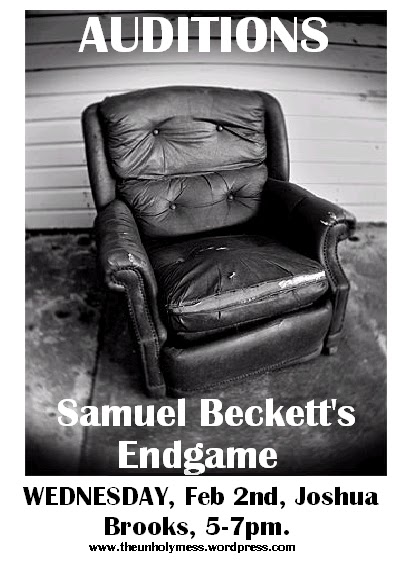
Come along and audition to be in this exciting independent production. No previous experience necessary, we are looking for enthusiastic, creative people with ideas to bring to the roles. We want to emphasise the play as a comedy, so actors should aim to draw out the pitch-black comedy in their auditions.
The roles:
Hamm: MALE. Protagonist. A blind tyrant, fallen from wealth and greatness, who is confined to a chair in the middle of the stage. He wavers from flashes of rage and brutality aimed at his parents Nagg and Nell and his servant Clov to simpering bouts of vulnerability.
Clov: MALE. Hamm’s beleaguered servant, Clov cannot sit down. He limps around the set, begrudgingly following Hamm’s orders. He repeatedly threatens to leave, but seems unable to do so; they are mutually reliant on each other in the waste-land they inhabit. He, like Hamm, seems to have lost his mind.
Nagg: MALE. Nagg is Hamm’s father and spends the entirety of the play in a metal bin because he has no legs. He reminisces mainly about the past and bemoans his current position.
Nell: FEMALE. Hamm’s mother. This is a small part. Nell, like Nagg, spends her time in a metal bin and has no legs. She is more morose than Nagg; whilst he spends his time trying to get her to remember when times were better, she cannot overcome her grief and dies.
Arrive any time from 5pm-7pm, extracts will be provided. Arrive early to avoid waiting. All the information (including the audition pieces) is on our blog at www.theunholymess.wordpress.com.
Give Blood!
Manchester Donor Walk-in Centre - just the other side of the Manchester Royal Infirmary, Plymouth Grove
Map (PDF, 172K)
Map (PDF, 172K)
Stachniewski Memorial Lecture, 16 February, 5pm
Stachniewski lecture - a reminder
The speaker this year is Professor Kate Chedgzoy, from the University of Newcastle. Her title is ‘Boys’ own stories: Children as poets and storytellers in Shakespeare’s England’. All welcome. Please circulate details.
Subscribe to:
Posts (Atom)